NASA's Artemis II mission represents a grand-cycle shift in aerospace engineering, moving from deterministic software systems to adaptive, data-driven intelligence. Unlike Apollo-era space missions, which relied heavily on human control and static rule-based logic, Artemis II integrates artificial intelligence, machine learning, and advanced data science pipelines as a foundational layer of mission-critical infrastructure.
Artemis II shows technology leaders that AI is no longer just a support tool. It now acts as a distributed system, helping make decisions in navigation, health monitoring, anomaly detection, and environmental prediction. This shift matters in deep space, where signal latency, unpredictable conditions, and complex systems make quick human responses difficult. The same strategy is valuable for any organisation facing high-stakes, data-heavy situations where downtime is not an option.
Let’s break down the mission and see which role AI plays at each stage, from launch to deep space.


AI-powered navigation without ground control
Once Orion passes beyond low Earth orbit, traditional navigation systems like GPS stop working, and there are no satellite data or ground beacons to help. The spacecraft has to figure out its position and direction using only its own observations.
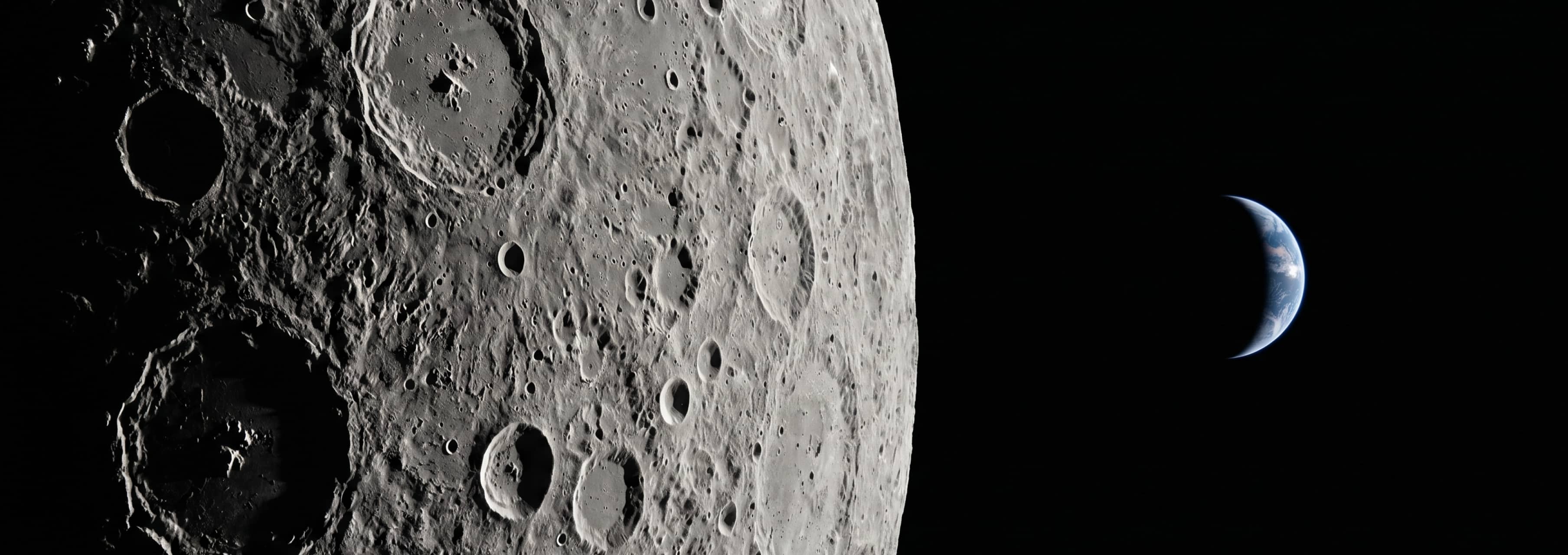
To address this, Artemis II leverages AI-driven optical navigation, a system that combines computer vision with astrodynamics. High-resolution cameras take pictures of astrobodies, mainly Earth and the Moon, against a star field (coordination). Convolutional neural networks (rather some custom topology) and feature-extraction algorithms analyse these images to identify known landmarks: large lunar craters, the Earth's limb. Using optical flow and parallax estimation, the system computes the spacecraft’s 6-degree-of-freedom (6-DOF) state vector, including position and velocity.
This data is continuously fed into the Guidance, Navigation, and Control (GN&C) system, enabling real-time trajectory corrections. It is fully offline, so it works even during communication blackouts.
The navigation model also incorporates multi-body gravitational dynamics, solar radiation pressure, and perturbation corrections, producing trajectory optimisations that would be computationally infeasible using classical legacy systems.
This capability marks a big step toward fully autonomous AI-based deep space navigation, and is a great prerequisite for future space missions to Mars where communication delays can exceed 20 minutes. The same approach can be applied to any system that needs to work reliably with little or no connectivity, using self-contained, AI-powered intelligence rather than relying on the cloud.
Monitoring spacecraft health with AI
With navigation running autonomously, the next layer of AI addresses a different problem: keeping the spacecraft itself healthy. Modern spacecraft generate massive volumes of telemetry data across thousands of sensors. Artemis II addresses this complexity using System Invariant Analysis Technology (SIAT)—an AI system that models spacecraft behaviour as a network of nonlinear relationships.
Unlike traditional monitoring systems that rely on static thresholds (if threshold reached then alerting/action), SIAT constructs a high-dimensional relational graph (not GNNs exactly, but let's simplify to this topology), capturing over 22 billion dependencies between variables such as temperature, pressure, and electrical load. By learning the "normal" operational state, the system can detect deviations in real time.
This is a classical paradigm for any anomaly detection system, for example, a minor increase in power consumption combined with a slight temperature shift, which is individually insignificant, may indicate early-stage component degradation when analysed relationally. SIAT identifies such patterns and provides explainable outputs or recommendations, including confidence scores and causal pathways, enabling rapid operator response.
In places like factories, data centres, energy grids, and logistics networks, failures usually don't show up as one variable going out of range. Instead, they happen when many factors change together. Moving from threshold-based monitoring to relational anomaly detection is one of the most valuable AI uses for industry, and SIAT shows how this can work on a large scale.
Hybrid AI for predicting solar radiation risks
One of the biggest risks in deep-space missions is exposure to solar particle events (SPEs), which are high-energy charged particles that can cause serious biological harm from proton radiation. Artemis II uses machine learning models to predict these events up to 24 hours ahead. The system looks at multi-spectral solar images from observatories like the Solar Dynamics Observatory (SDO) and SOHO, applying temporal ML models (forecasting tasks) to spot patterns linked to solar flares and coronal mass ejections.
However, because ML models output probabilistic predictions, NASA integrates these outputs with physics-based particle propagation simulations. This hybrid AI approach enables real-time monitoring of radiation conditions and supports several operational decisions like reconfiguring spacecraft shielding, adjusting crew positioning, maintenance, etc.
Bringing together AI and physical modelling shows how next-generation AI systems can work in high-risk situations.
AI-driven biometric monitoring and predictive health systems
Astronauts in deep space face challenges like microgravity, radiation, and psychological stress. To keep them safe and performing well, Artemis II uses an AI-powered continuous biometric monitoring system that constantly keeps an eye on their health with wearable sensors that track heart rate, sleep, reaction times, and radiation exposure. Those wearables were not typical fitness/smart watches; the only watch they wore was the Omega Speedmaster X-33, a historical choice from 1969. Machine learning models then review the data to catch early signs of stress, tiredness, or cognitive decline. For instance, if reaction times slow down and sleep patterns change, it could mean the crew is less ready for tasks or is having trouble thinking clearly.
The mission also features advanced bio-AI experiments, including organ-on-chip systems (project AVATAR, living human cells experiment), which simulate human tissue responses to radiation and microgravity. These systems use AI to model cellular behaviour and predict long-term health impacts, informing countermeasures for future missions.
Such integration of biomedical data science and AI transforms (or will transform after the experiment) astronaut health management into a predictive, personalised system.
Resilience through AI-enabled self-healing systems
In deep space, immediate human intervention is not always possible. Artemis II tackles this by using AI-enabled self-healing systems that can find, isolate, and fix problems on their own. When the system spots an issue, it can:
- reroute power around damaged components;
- adjust life support parameters;
- reconfigure subsystems to maintain operational integrity.
These capabilities rely on pattern recognition and further decision-making models trained on thousands of simulated failure scenarios. The result is that spacecraft capable of adaptive resilience, maintaining functionality even under partial system degradation. Meanwhile, the concept of self-healing infrastructure is well established in software engineering; Artemis II demonstrates the extension of this philosophy to physical systems with AI as the decision layer.
AI-enhanced communication and human-machine interaction
Communicating across deep space is difficult because of high latency and limited bandwidth. Artemis II uses AI-powered delay-tolerant networking (DTN) to make data transmission more efficient. The system uses neural compression for data encoding, priority-based packet scheduling, and applies machine learning models for denoising and error reconstruction. These systems also ensure that critical data (navigation, telemetry) is transmitted reliably, even under constrained conditions.
Artemis II integrates AI-driven natural language interfaces to make it easier for astronauts to interact with the spacecraft, reducing their cognitive load.
The Callisto system, powered by voice AI technology and developed in partnership with Lockheed Martin, Amazon Alexa, and Webex by Cisco (let's assume this is based on Alexa), allows astronauts to query system status, access technical documentation, and retrieve mission data using conversational commands. But due to limited connectivity, the system is local and is a form of edge AI, performing speech recognition without relying on cloud infrastructure. Acoustic modelling compensates for the spacecraft’s challenging audio environment, characterised by low signal-to-noise ratios and high reverberation.
The backbone of AI in the mission phases
Every AI system described above, from navigation to fault management to voice interaction, depends on a common infrastructure layer that makes mission-critical AI possible in the first place: digital twin simulations.
Even during launch, AI plays a critical role. The Space Launch System (SLS) utilises AI-driven control loops capable of performing thousands of adjustments per second, optimising engine thrust levels, fuel consumption, stages separation timing, or abort decisions. These real-time optimisations ensure maximum efficiency and safety during one of the most dynamic phases of the mission.
The key enabler of these systems is the use of digital twin simulations (virtual replicas of spacecraft systems used for training and validation), where there is a huge place for ML models, which are trained on thousands of simulated scenarios, including failure modes and environmental variations. This allows AI systems to generalise effectively to real-world conditions, enhancing robustness and reliability.
Conclusions
Artemis II demonstrates that AI is no longer an auxiliary or unproven/stochastic technology; it is now the core operational backbone of modern aerospace systems, its use not limited to our current list of modules/systems. And who knows, maybe that jar of Nutella floating inside the Orion spacecraft is thanks to an AI-driven onboard promo campaign 😉
The role of AI in space exploration extends well beyond a single mission. DS/AI capabilities are not limited to space exploration: they define a broader trend across high-tech, high-stakes industries, including healthcare, defence, energy, and autonomous agents, where failure is costly and real-time decision-making is critical. As humanity pushes further into deep space, AI will not just accompany us; it will enable the journey itself, acting as a silent but vital partner in the exploration of the unknown.


Related Insights








The breadth of knowledge and understanding that ELEKS has within its walls allows us to leverage that expertise to make superior deliverables for our customers. When you work with ELEKS, you are working with the top 1% of the aptitude and engineering excellence of the whole country.

Right from the start, we really liked ELEKS’ commitment and engagement. They came to us with their best people to try to understand our context, our business idea, and developed the first prototype with us. They were very professional and very customer oriented. I think, without ELEKS it probably would not have been possible to have such a successful product in such a short period of time.

ELEKS has been involved in the development of a number of our consumer-facing websites and mobile applications that allow our customers to easily track their shipments, get the information they need as well as stay in touch with us. We’ve appreciated the level of ELEKS’ expertise, responsiveness and attention to details.