AI spending and market momentum
Global artificial intelligence spending is projected to reach $337 billion in 2025 and more than double to $749 billion by 2028 (IDC). Gartner confirms the momentum: AI and generative AI are the top two investment priorities for technology executives in 2026, with 91% of organisations increasing their GenAI budgets.


This gap exists, in large part, because generic AI tools are designed for broad applicability — which means they're optimised for no one in particular. They operate within vendor-defined constraints and follow roadmaps built for market averages, not the specific data, logic, and competitive priorities that define your business. Organisations seeing real returns are approaching AI differently: building systems designed around their own data, processes, and strategic objectives.

AI projects featuring specialised external AI expertise succeed approximately 67% of the time, compared to just 33% for internal builds using generic tooling (Trullion analysis of MIT data).
That's the core argument for custom AI solutions. This article examines what they entail, where they outperform off-the-shelf alternatives, how to approach implementation, and what to look for in a development partner.
What are custom artificial intelligence solutions?
Custom AI solutions development delivers systems designed around your organisation's specific needs, data, and workflows. Rather than adapting business processes to fit a generic tool, a custom solution is built around them — giving organisations full control over data processing, algorithm selection, and integration with existing infrastructure. Off-the-shelf solutions simply don't offer this degree of customisation.
Industry use cases of custom AI solutions
- Healthcare. One of the high-stakes industries, healthcare sees bespoke solutions enabling medical imaging analysis with deep learning, predictive analytics for patient care, and personalised treatment and diet plans. Unlike generic systems, these solutions integrate patient data with medical research while maintaining strict regulatory compliance standards s.
- Financial services. Financial services, where the cost of a missed signal can be significant, see organisations building fraud detection and prevention models trained on proprietary transaction data, alongside AI-powered risk assessment and automated compliance reporting — identifying patterns and anomalies that generic models, trained on generalised data, would miss entirely.
- Manufacturing. AI drives predictive maintenance using equipment-specific sensor data, computer vision for defect detection, and energy management optimisation — delivering operational improvements that no standardised tool can replicate at this level of precision.
- Retail. Retailers apply AI to demand forecasting, inventory management, and dynamic pricing. Personalised shopping recommendations leverage natural language processing and historical data unique to their operations and customer base.
- Logistics. Artificial intelligence and optimisation power dynamic route planning, fleet management, last-mile delivery, and supply chain optimisation — capabilities that require deep integration with proprietary operational data to function effectively.
- Insurance. Insurers use custom AI for underwriting automation, claims processing, fraud detection, and personalised product development, with compliance and data governance built into the architecture from day one.
How custom artificial intelligence systems work
Unlike off-the-shelf tools that use a one-size-fits-all approach, custom AI systems are built specifically for your data and workflows. Advanced retrieval architectures — including customised Retrieval-Augmented Generation (RAG) and Knowledge Graph-based agents (KAG) — allow these systems to reason over proprietary, industry-specific data rather than broad training sets, producing outputs grounded in your enterprise intelligence rather than generalised assumptions.
AI agents are evaluated against defined behavioural expectations, guardrails, and cost efficiency benchmarks. Data scientists test them against real-world scenarios to ensure agents respond accurately, operate within established boundaries, and perform reliably at scale.
Custom solutions are designed to integrate with existing enterprise systems and legacy infrastructure from the outset, eliminating the need for later workarounds. This creates a unified intelligence layer across all operational channels, ensuring consistent application of insights and automation throughout the business.
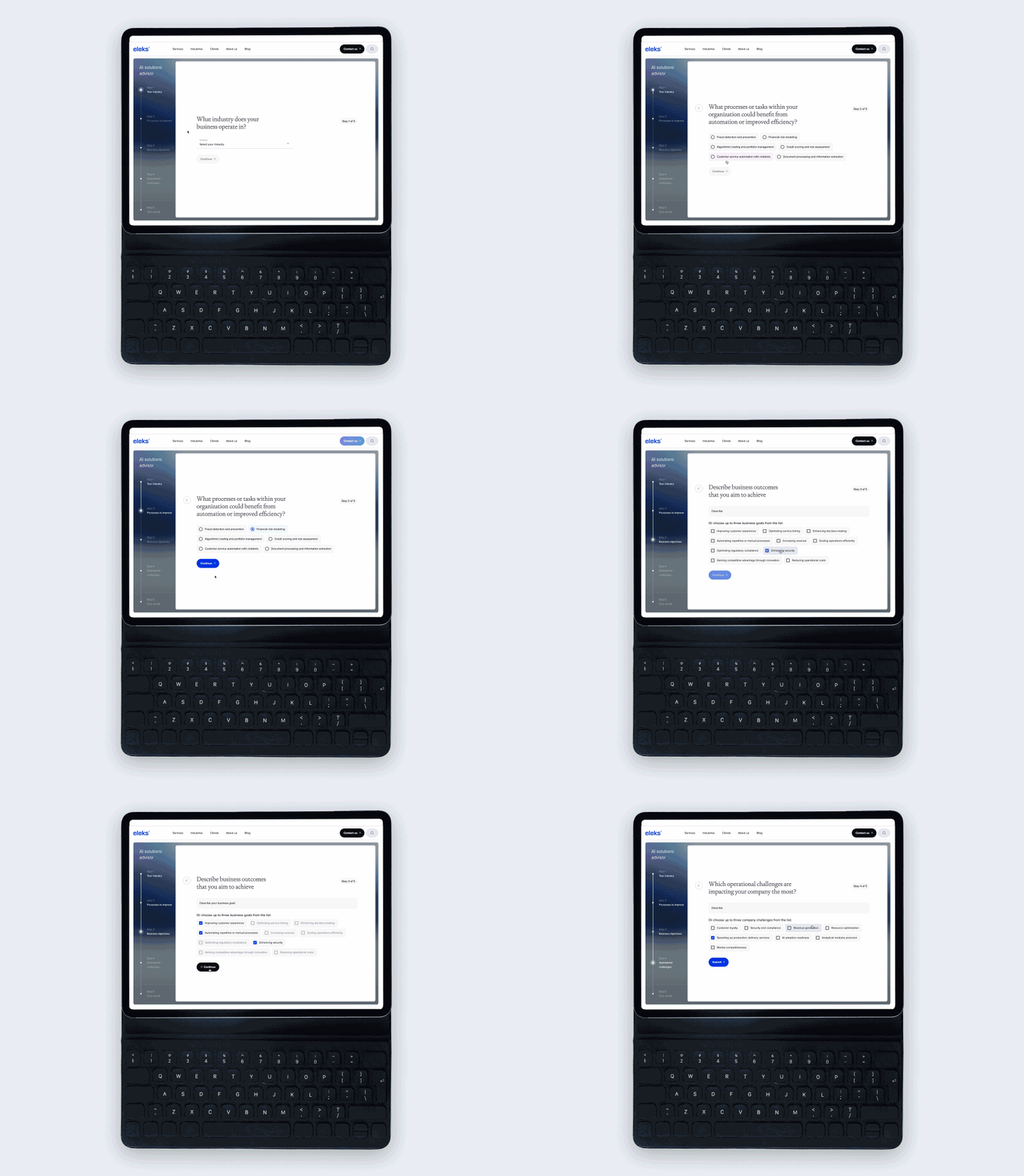

If you aim to deliver differentiated customer experiences or innovative value beyond what generic platforms offer, custom AI lets you design interactions and workflows around your users' most important outcomes. Rather than being constrained by a vendor's roadmap, you retain full control over how your AI evolves.

If you have proprietary datasets that competitors cannot access, custom AI agents prepared for this data can create a sustainable competitive advantage that off-the-shelf tools cannot replicate.

In industries with strict data handling obligations, such as healthcare, financial services, government or insurance, generic solutions often cannot meet compliance requirements without significant compromise.

Organisations with legacy infrastructure or highly specialised systems often find that custom AI integrates more reliably than generic tools, which may require costly middleware and workarounds.

When accuracy, speed, or output quality must meet specific performance benchmarks critical to your operations, off-the-shelf tools optimized for broad use may not be sufficient to match these standards

When your business requires sophisticated multi-step processes, autonomous agent behaviour, or innovative customer engagement that generic platforms are not designed to support, custom development allows you to build the logic, flows, and interactions that create genuinely differentiated user experiences.

If AI capabilities are central to your competitive position, the risks of relying on a vendor's roadmap and generic functionality outweigh the convenience of an out-of-the-box solution.
Success with custom AI solutions relies on organisational readiness. As with any major technology initiative, proactive planning, strong governance, and realistic timelines are essential.
Common AI integration challenges, such as data quality, integration complexity, and stakeholder alignment, can be managed with the right approach and partner. Organisations that adopt iterative development, rather than expecting immediate full functionality, achieve better results.
Custom AI software development lifecycle
For organisations that have determined custom AI is the right path, a structured implementation approach is what separates successful deployments from stalled projects. While every engagement differs, the process typically follows six phases.
Phase 1: Discovery and objective definition
The process begins with a clear understanding of the problem to be solved. This includes defining the decisions the AI will support, outlining success criteria, and selecting relevant KPIs. At ELEKS, we start each AI project with a comprehensive discovery phase, examining existing data, assessing the business ecosystem, and identifying areas where AI can deliver the greatest value. Aligning stakeholders at this stage helps prevent costly changes later.
Phase 2: Data strategy and collection
High-quality data is the foundation of any successful AI implementation. This phase involves auditing existing datasets, identifying gaps, establishing a data governance framework, and designing the data pipelines needed for both training and production. Both structured and unstructured data, such as documents, operational records, and proprietary knowledge bases, must be properly assessed and prepared.
Phase 3: AI solution design and architecture
Based on the business problem, the team selects an appropriate approach, which may include applying machine learning, deep learning, natural language processing, computer vision, generative AI, or predictive analytics. Infrastructure decisions regarding cloud, edge, or hybrid deployment are made at this stage, along with scalability planning to support future growth without major redesign.
Phase 4: Development and training
Data scientists build and evaluate AI agents using deterministic metrics and an LLM-as-a-judge approach, ensuring correct behaviour, low hallucination rates, and appropriate responses across edge cases. Evaluation criteria cover precision, absence of bias and discrimination, data leakage prevention, and control loss risk — validating that agents perform reliably, safely, and within defined boundaries before and after deployment.
Phase 5: Deployment and integration
Our team at ELEKS uses an agile development approach to ensure the custom AI agent integrates seamlessly with the client’s operational framework and infrastructure. This phase includes security protocol setup, system integration testing, and user training, because even the most technically sound solution only delivers value if people are confident using it.
Phase 6: Monitoring and continuous improvement
Deployment is only the beginning. Agentic AI requires ongoing attention to maintain accuracy as conditions evolve. Real-time performance tracking, automated alerts for model drift, regular agent tuning and configuration revision, and user feedback loops ensure the solution continues to perform and adapts to changing business needs.
Future trends in custom AI agents development
Successfully deploying a custom AI solution is only the beginning. The broader landscape of AI agents development continues to evolve rapidly, and the organisations seeing the greatest long-term returns are those that build their AI systems with future adaptability in mind.
Several trends are reshaping how enterprises approach custom AI development in 2026 and beyond.
MLOps maturation and the rise of LLMOps in custom AI operations
MLOps, which integrates DevOps with data science and machine learning engineering, is becoming the operational backbone of custom AI solutions. It shortens model development cycles, accelerates iteration, enables continuous monitoring, and simplifies retraining as new data emerges. For organisations deploying custom AI agents at scale, MLOps is also evolving into LLMOps — extending these practices beyond machine learning models to cover the full spectrum of AI operations, including intelligent automation, anomaly detection, and autonomous incident response. LLMOps reduces technical debt, enhances scalability, and helps sustain ROI as AI systems grow in complexity. ELEKS' LLMOps services support the entire process, from infrastructure setup and CI/CD deployment to model monitoring and ongoing optimisation.
Explainable AI: from good practice to compliance requirement
Explainable AI is becoming increasingly important as regulations tighten. The EU AI Act and frameworks such as DORA require organisations to demonstrate transparency and human oversight in AI decision-making. As a result, the ability to explain model outputs is now a compliance requirement rather than a best practice. Custom AI offers a clear advantage, as explainability can be integrated into the architecture from the outset instead of being added to an existing black-box platform.
Hybrid AI architectures: orchestrating specialised models at scale
Hybrid AI architectures, which combine multiple specialised models to address different aspects of complex enterprise workflows, are becoming standard practice. Instead of relying on a single generalist AI model, organisations are implementing layered systems where each component is optimised for a specific task. Human oversight ensures accuracy, reliability, and strategic alignment.
Edge AI: real-time intelligence closer to the source
Edge AI deployment is expanding viable use cases, especially in manufacturing, logistics, and healthcare. Processing data locally instead of through centralised cloud environments reduces latency, improves security, and enables real-time decision-making where connectivity or data residency constraints make cloud-only solutions impractical.
Federated learning: collaboration without compromising data privacy
Federated learning is gaining traction in industries where data cannot be centralised due to privacy or regulatory requirements. By training models on distributed datasets without transferring the underlying data, organisations can collaboratively improve model performance while maintaining data privacy.
These trends indicate that custom AI solutions are becoming more accessible, operationally mature, and integrated into enterprise infrastructure. Organisations that invest in sound architecture, robust MLOps practices, and compliance-aware design today will be well-positioned to benefit from these developments.
Choosing a partner for custom AI software development
Selecting the AI development vendor is one of the most important decisions in any custom AI project. The right partner brings more than technical capability — they bring the domain knowledge, delivery experience, and long-term commitment needed to turn an AI initiative into a production-grade solution that delivers real business value.
There are a few qualities worth prioritising in your evaluation.
- Cross-domain expertise. Look for a partner with proven experience in your specific domain, one that understands your data, your workflows, and your regulatory environment. Domain knowledge shapes model design, data selection, and output validation in ways that general technical competence alone cannot replicate.
- End-to-end delivery capability. Look for a vendor that supports every stage, from ideation and feasibility assessment through to implementation, integration, and ongoing maintenance. This approach reduces handoff risks and maintains accountability throughout the entire project.
- Strong software engineering foundations. Models must integrate into real systems, handle large data volumes, and perform reliably under operational conditions. An AI development company that combines artificial intelligence and data science expertise with custom software development capability is better positioned to deliver a working production system.
- Security and compliance are built in from the start. In regulated industries like financial services, healthcare, insurance, or government, compliance is a critical requirement. Choose an AI vendor that treats cybersecurity and regulatory requirements as integral to development.
- Transparency and realistic expectations. The right partner will ask difficult questions upfront, assess your organisation's readiness honestly, and set realistic timelines and ROI expectations, even when the answers are not what you want to hear.
Final thoughts
Custom AI development is not suitable for every organisation. However, for those in complex, data-intensive, or regulated environments, it is often the more strategic option. While generic tools can provide quick results, they often fall short of meeting the specific needs of enterprise operations, proprietary data, and changing compliance requirements.
Organisations achieving real returns from AI integration in 2026 are those that have moved beyond experimentation and made intentional decisions about building, deploying, and managing their AI systems. They view AI as an integral part of their operations and competitive strategy, rather than a standalone technology project.
Achieving this requires strong foundations: high-quality data, clear business objectives, a structured implementation approach, and a development partner who understands both the technology and its business context. These elements are essential and distinguish successful AI initiatives from those that stall at the pilot stage.
For most enterprises, the question is no longer whether to invest in custom AI, but how to do so in a realistic, well-governed, and strategically aligned manner.




Related Insights









The breadth of knowledge and understanding that ELEKS has within its walls allows us to leverage that expertise to make superior deliverables for our customers. When you work with ELEKS, you are working with the top 1% of the aptitude and engineering excellence of the whole country.

Right from the start, we really liked ELEKS’ commitment and engagement. They came to us with their best people to try to understand our context, our business idea, and developed the first prototype with us. They were very professional and very customer oriented. I think, without ELEKS it probably would not have been possible to have such a successful product in such a short period of time.

ELEKS has been involved in the development of a number of our consumer-facing websites and mobile applications that allow our customers to easily track their shipments, get the information they need as well as stay in touch with us. We’ve appreciated the level of ELEKS’ expertise, responsiveness and attention to details.