
Successful organizations carefully choose between custom AI solutions and off-the-shelf products, which shapes their long-term competitiveness. This guide gives technology leaders the key facts about custom AI software: what it is, when to use it, and best practices for getting started.
The AI market landscape in 2026
AI-driven automation now captures 41% of all new technology investment globally. No other category commands that share. The spending breaks down into three segments: AI infrastructure at $1.37 trillion, AI software at $452 billion, and AI services at $589 billion.
AI adoption is broad but uneven. 64% of organizations actively use artificial intelligence. Among companies with 1,000 or more employees, the number climbs to 76%, according to McKinsey. Agentic AI is the fastest-growing segment, with 78% of Fortune 500 companies expected to adopt it in 2026. That market alone will reach $89.6 billion, representing 215% growth.
But here is the problem. 42% of companies abandoned most of their AI initiatives in 2025, up from 17% the prior year. The average organization scrapped 46% of its AI proofs-of-concept before reaching production. Failure stems from strategic misalignment, poor integration alongside existing workflows, and weak change management.
The financial services sector leads AI spending at $73 billion. Healthcare AI reaches $50.70 billion with a 38.9% compound annual growth rate. Manufacturing focuses investment on predictive maintenance, with that market growing from $11 billion to over $70 billion by 2032, according to Fortune Business Insights. Research by BCG shows corporations planning to double their AI budgets from 0.8% to 1.7% of revenues.
These numbers show that the real challenge is not how much is spent on leveraging AI, but how well that money is used.
What is a custom AI solution?
A custom AI solution is software built specifically for one organization, optimized to solve its unique business problems. This is very different from off-the-shelf AI products. Custom AI software processes the company’s own data. The models are trained on the organisation’s datasets and integrate directly with existing systems such as ERP and CRM. The company controls the infrastructure and keeps full ownership of the intellectual property.
Off-the-shelf AI comes as ready-made software, typically delivered as SaaS or via licenses. Vendors train these models on general or combined data. Integration is done with standard APIs, and customization is limited. The vendor keeps the intellectual property.


Key elements of custom AI-based software

Raw data flows from source systems through validation, transformation, and storage. Enterprise data lives in silos. Pipelines must handle both batch and streaming data while enforcing quality checks and lineage tracking.

Problem definition comes first. Feature engineering extracts signals from raw data. Machine learning model selection balances accuracy, interpretability, and computational cost. Validation prevents overfitting. Version control tracks iterations.

Trained models must serve predictions in production. Latency requirements vary. Fraud detection needs a sub-100-millisecond response. Batch forecasting can tolerate minutes.

A custom AI solution must connect to enterprise systems. Legacy mainframes, SCADA controllers, and EHR platforms usually lack modern interfaces. Adapters and middleware bridge the gap.

Production AI requires drift detection, performance tracking, and automated alerting. Machine learning models degrade as input distributions change. Without monitoring, degradation goes unnoticed.

AI systems introduce unique security risks. Training data protection, adversarial attack defense, and model theft prevention are all concerns. Regulatory compliance (HIPAA, PCI-DSS, EU AI Act) must be embedded from the start.
Types of custom AI solutions
Custom AI software spans six major categories, each addressing different enterprise needs:
- Predictive analytics and forecasting. Demand forecasting, risk modelling, and revenue projection. These systems use structured data and time series methods. Financial services and manufacturing are the heaviest users.
- Natural language processing, generative AI, and conversational AI. Document classification, sentiment analysis, chatbots, and clinical note summarization. Large language models have expanded capabilities, but enterprise deployment requires fine-tuning, guardrails, and domain-specific knowledge bases.
- Computer vision and image recognition. Quality inspection in manufacturing, medical imaging in healthcare, and damage assessment in insurance. Deep learning achieves human-level performance on many visual tasks.
- Recommendation engines and personalization. Next-best-action in sales, personalized customer experiences and treatment plans, and tailored product recommendations. Custom machine learning models train on proprietary customer behavior that off-the-shelf systems cannot access.
- Autonomous decision systems and agentic AI. Multi-step task execution with little human intervention. Applications include automated customer onboarding, intelligent document processing, and supply chain optimization. This is the fastest-growing category.
- Process automation and intelligent workflows. AI augments business process automation through document routing, entity extraction, and anomaly detection. ROI comes from throughput improvement across high-volume operations.
Custom AI solutions vs off-the-shelf options
| Factor | Off-the-shelf | Custom AI system |
|---|---|---|
| Data ownership | Shared/vendor | Full enterprise control |
| Integration depth | Surface-level APIs | Deep, native connections |
| Competitive advantage | Parity | Proprietary differentiation |
| Compliance control | Vendor-dependent | By design |
| Vendor dependency | High | Low |
Off-the-shelf solutions are cheaper in the first year, but bespoke solutions become more cost-effective with time. Licensing costs for off-the-shelf products add up, while custom AI development costs are spread out. For complex domain-specific AI projects, custom becomes the better choice.
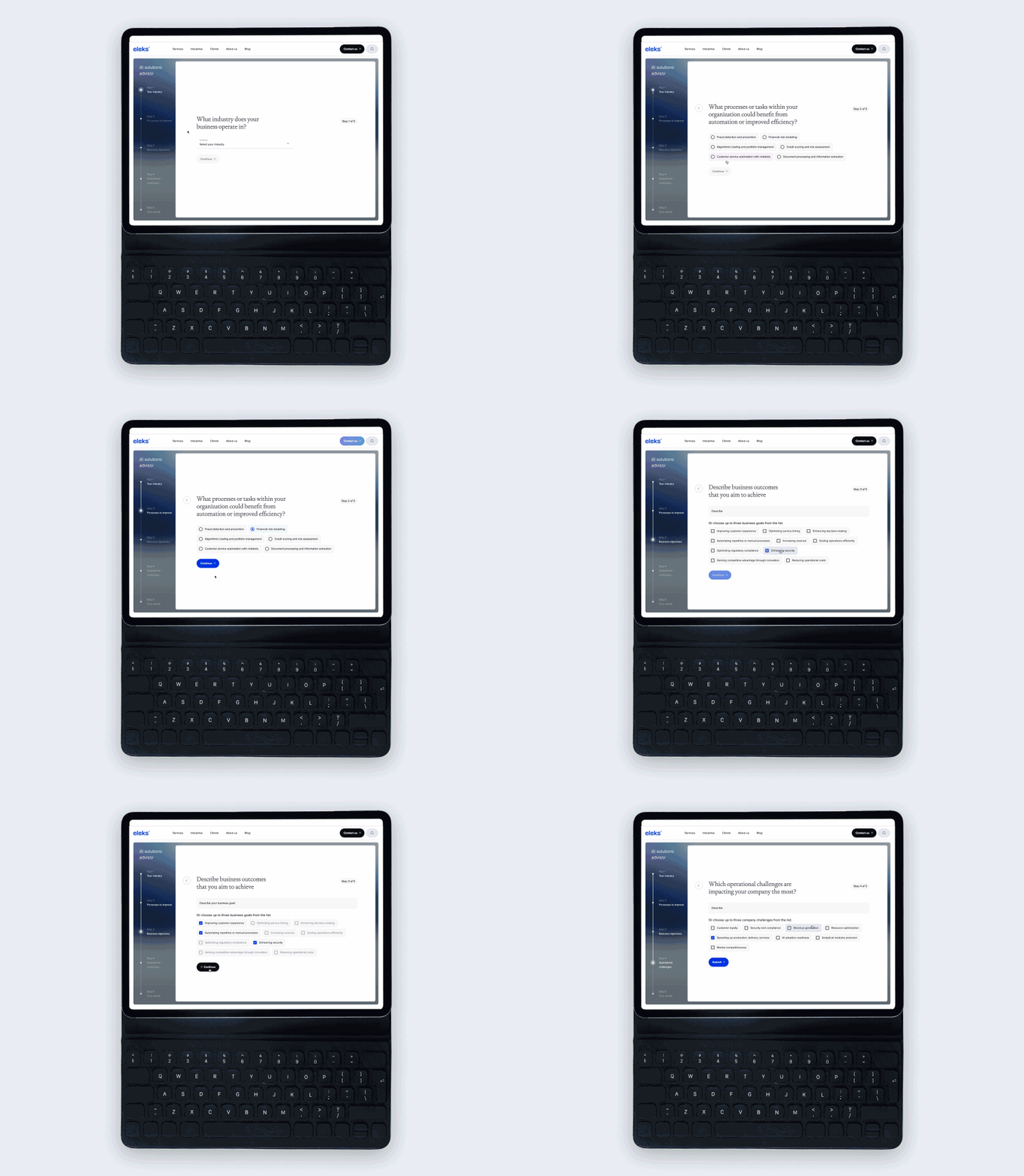

Key steps in the development process of a custom AI solution

Validate the business case. Audit data quality and availability. Assess feasibility. Align stakeholders.

Design data pipelines. Establish quality frameworks. Define governance models. Make architecture decisions. Data quality is the primary barrier to AI success.

Engineer features. Select and train models. Validate performance. Document assumptions and limitations. Iterative development with clear milestones keeps projects on track.
Develop APIs. Connect to enterprise systems. Test end-to-end. Deploy using blue-green or canary methods to reduce risk.

Monitor production performance. Find and fix drift. Automate retraining. Plan capacity for growth. Production operations account for half the work and neglecting them leads to gradual degradation.
How to choose a custom AI development partner
Discovery and requirements phase
The right partner starts by understanding your business problem, not selling technology. Evaluate whether potential partners ask about business objectives before proposing solutions. Partners should demonstrate experience in your industry with verifiable case studies and measurable outcomes.
Key evaluation criteria include AI strategy (knowing when to build vs. buy at the component level), MLOps maturity (CI/CD for models, monitoring, automated retraining), and infrastructure capability (cloud, on-premises, and hybrid deployment experience).
Development and training process
Assess the partner's delivery methodology. Structured approaches with clear phases and gates outperform ad-hoc processes. Ask about production success rates.
Verify the team composition. Senior AI architects, ML engineers, data engineers, and LLMOps specialists should be available.
Deployment and integration
Legacy system integration is the critical differentiator. Most enterprise AI projects involve connecting to systems built over decades. Generic AI consultancies usually lack this depth. Ask for specific examples of mainframe integration, SCADA connectivity, or EHR interface development.
Evaluate security and compliance capabilities. AI technologies introduce unique concerns: adversarial attacks, data poisoning, and model theft. Partners should demonstrate experience with industry-specific frameworks (HIPAA, PCI-DSS, SOC 2, EU AI Act).
Finally, ensure knowledge transfer is part of the engagement. Documentation, training, and handover support should build internal capability. The best partnerships enable independence over time, not dependency.
Risks and limitations of custom AI software development
Technical and resource risks
- Data quality. Poor data undermines every AI development initiative. Mitigation requires upfront data audits and continuous quality monitoring.
- Model drift. Input distributions change over time. Customer behaviour shifts. Market conditions change. Without drift detection and automated retraining, models degrade silently.
- Integration complexity. Enterprise systems cover decades of technology. Mainframes, legacy ERP, and modern cloud services coexist. Integrating AI technologies requires specialised expertise and thorough testing.
- Talent shortage. Data scientists, ML engineers, and MLOps specialists remain in high demand. Partnering with experienced vendors addresses short-term gaps while building internal capability through knowledge transfer.
Business and strategic-level limitations
A custom AI solution is not right for every use case. Commodity capabilities (internal chatbots, generic document summarization) may not justify custom investment. Time-to-market pressure may favour the rapid deployment of off-the-shelf tools. Limited budgets may constrain scope.
The EU AI Act imposes new obligations for high-risk AI systems starting August 2026. Non-compliance carries penalties up to 35 million euros or 7% of global turnover. Organizations serving EU markets must factor compliance into development timelines and costs.
Mitigation strategies
Structured methodology reduces risk significantly. Phased approaches with clear gates prevent investing heavily in doomed projects. Discovery phases validate feasibility before major spending. Data strategy phases catch quality issues before they impact model development. Compliance-by-design embeds regulatory requirements from the start rather than retrofitting them later.
Organizations planning AI adoption should set realistic expectations. Checking ROI too early can lead to projects being stopped before they have a chance to succeed.
Conclusion and next steps
Custom AI software delivers the strongest long-term returns for enterprises where AI is strategic. The competitive advantages compound over time. But success requires disciplined execution: a structured methodology, investment in data quality, and realistic expectations.
Three instant actions for enterprise leaders:
- Conduct an AI readiness assessment. Evaluate your organization's maturity across data governance, technical infrastructure, talent, and organizational readiness. Identify gaps before committing to development.
- Identify a pilot use case. Choose a use case with clear business impact, available data, and executive sponsorship. Start with the highest-impact, lowest-complexity opportunity. Prove value before scaling.
- Evaluate development partners. Look for domain expertise in your industry, production track records with measurable outcomes, structured delivery methodology, and compliance capabilities. Reference checks validate claims.
The chance to gain an edge with AI technologies is shrinking. Companies that start building custom AI systems now will obtain valuable data, knowledge, and experience that will be hard for others to match later.



Related Insights








The breadth of knowledge and understanding that ELEKS has within its walls allows us to leverage that expertise to make superior deliverables for our customers. When you work with ELEKS, you are working with the top 1% of the aptitude and engineering excellence of the whole country.

Right from the start, we really liked ELEKS’ commitment and engagement. They came to us with their best people to try to understand our context, our business idea, and developed the first prototype with us. They were very professional and very customer oriented. I think, without ELEKS it probably would not have been possible to have such a successful product in such a short period of time.

ELEKS has been involved in the development of a number of our consumer-facing websites and mobile applications that allow our customers to easily track their shipments, get the information they need as well as stay in touch with us. We’ve appreciated the level of ELEKS’ expertise, responsiveness and attention to details.