Data anonymization
services
What you get with ELEKS' data anonymization services
We provide customized anonymization solutions to help companies establish effective privacy practices, securely use data for LLM applications, and stay compliant with regulations. Our clients can improve organizational security, lower privacy risks, strengthen customer trust, and accelerate AI projects with confidence that their stored data is protected.
With extensive expertise in data science and AI development, we ensure that anonymized data maintains its context and usability for online LLM services and third-party platforms while fully protecting sensitive information from exposure. From initial assessment to technique selection, implementation, and compliance monitoring, our teams manage every stage of the anonymization process.
The data anonymization techniques we use
-
Contextual replacement
We generate realistic, context-aware substitutes for sensitive data using machine learning models, efficient heuristics and offline SLMs that preserve the original format and meaning of the information. This technique ensures anonymized data maintains its business value while protecting individual privacy through replacements that fit naturally within the sample or query.
-
Pseudonymization
With this method, we substitute direct identifiers with pseudonyms or artificial identifiers. The data can be re-identified when needed through secure key management. This approach provides privacy protection while maintaining data relationships and allowing authorized access to the original information for legitimate purposes.
-
Format-preserving randomization
By using format-preserving randomization, you can maintain the original data format while making the information unreadable and unrecoverable. This technique is essential for protecting structured data, such as credit card numbers, phone numbers, and identification codes, while preserving their functional characteristics for seamless processing by external services.
-
Synthetic data generation
Synthetic data generation produces completely artificial datasets that statistically resemble the original data without including any real personal information. This method eliminates privacy risks while providing realistic test data for development, analytics, and training machine learning models.
-
Data perturbation
We modify original data values by adding controlled noise or slight variations. This way we can preserve statistical properties while protecting individual privacy. This technique is particularly relevant for numerical data, where maintaining distribution patterns is crucial for accurate analysis.
-
Removal and suppression
We selectively remove or obscure specific data fields that pose privacy risks while preserving the utility of the remaining information. This technique is ideal for scenarios where it is acceptable to eliminate certain sensitive elements without affecting the data's analytical value.
-
Data masking
The data masking method replaces sensitive data with fictional yet realistic characters, symbols, or values with tags like "[Date]", preserving the original data structure. This technique helps protect personally identifiable information while allowing the system to function normally.
-
Data swapping
With the data swapping technique, we rearrange attribute values between different records to break the link between individuals and their sensitive information. This approach maintains the overall statistical distribution of the dataset while making it impossible to identify specific individuals through their unique data combinations.
The benefits of ELEKS’ data
anonymization services
With our expert help, you can use your data with AI tools while still adhering to legal requirements and safeguarding client privacy. Our anonymization methods preserve statistical validity for model training without disclosing sensitive information. Our fully offline and local service ensures no data leakage to external systems, while optimized processing adds only milliseconds of latency to your workflows.
Our contextual anonymization approach preserves data meaning and context, ensuring your anonymized data retains its business value without compromising privacy. Your leadership will be able to use data analytics to identify trends, predict business outcomes, and make strategic decisions while maintaining the highest standards of data security.
By anonymizing only the sensitive data portions, you can avoid the massive costs of keeping entire agentic services offline while maintaining complete data security. This targeted approach allows you to leverage cost-effective online AI services for non-sensitive operations while protecting the most sensitive internal data.
When customers know their personal data is safeguarded through anonymization, they're more inclined to engage with your product or service. This increased trust leads to a stronger brand reputation, improved sales, and higher customer lifetime value, as clients feel assured that their privacy is respected and protected.
We can help you implement data governance policies and procedures that protect information integrity while ensuring compliance with regulatory requirements, such as the GDPR and HIPAA, among others. Our systematic approach to data anonymization helps you establish quality controls, security protocols, and compliance measures that build trust in your data ecosystem while reducing re-identification risks.
Our solution supports many data types and offers flexible anonymization strength and selectivity, allowing you to customize protection levels based on your specific business requirements. You can leverage more efficient and larger online models instead of being limited to offline alternatives, maximizing both performance and cost-effectiveness for your AI initiatives.
We start by analyzing your data to find all sensitive information and identify its usage (requests, daily activities) across your systems, databases, and file repositories. Our data engineering specialists and security experts assess privacy risks, regulatory requirements, and business objectives to create a detailed list of data elements that need protection.
Based on our discovery findings, our team selects the optimal combination of anonymization techniques, considering factors like data types, compliance requirements, intended analytical purposes as well as the expected performance of the LLM or AI agent. We focus on balancing privacy protection with data utility for your specific use cases.
At this stage, we integrate our offline data anonymization solution and apply chosen techniques to your sensitive information. Our process involves thorough testing, quality assurance, and validation to confirm that the anonymized data satisfies security standards and business needs.
After receiving responses from AI agents or external services, our decoder component automatically restores the original data context while preserving the valuable insights or outputs generated. This ensures you receive meaningful, actionable results that align with your original data structure and business requirements.
We offer ongoing monitoring of your anonymization processes to ensure consistent protection and optimal performance as your data environment shifts. Our team conducts regular audits, optimizes techniques, updates compliance measures, and provides technical support to protect sensitive data and keep your anonymization solution effective.

Our clients benefit from decades of experience in data science, machine learning development, MLOPs, LLMOps, and cybersecurity, all of which are applied to every anonymization project. Our experts understand the complexities of data protection and how data needs to be anonymized for AI, so it maintains its utility for machine learning model training and testing.
ELEKS delivers end-to-end privacy solutions that combine security and flexibility. Our holistic approach to data anonymization ensures seamless integration across your entire data ecosystem, enabling you to accelerate compliance while maintaining the analytical value of your data.
We tailor our data anonymization techniques to meet your industry-specific needs and regulatory requirements. This personalized approach ensures that our anonymization methods address your specific data privacy challenges.

Data anonymization FAQ
Data anonymization refers to the process of removing or transforming personally identifiable information (PII) and any confidential data from datasets and anywhere it's in use to protect individual privacy. This method guarantees that people cannot be identified again from the processed information while maintaining the analytical value of the data. Data anonymization allows businesses to comply with privacy laws such as GDPR and HIPAA while still using their data to gain business insights.
Anonymizing services help organizations systematically protect sensitive data through privacy-preserving tools and techniques as well as to prevent this information from being shared outside the company. Professional anonymizing services provide specialized expertise in methods like contextual replacement, dynamic data masking, synthetic data generation, and format-preserving encryption that may be difficult to implement in-house. They ensure organizations can use their data assets safely and meet regulatory requirements.
An example of anonymous data might be a customer database where names are replaced with unique identifiers, addresses are generalized to the city level, and birth dates are converted to age ranges. In healthcare, anonymous data could be patient records where specific diagnoses are kept, but all identifying details like names, addresses, and exact dates are removed or altered. The best anonymization preserves important contextual consistency—maintaining gender appropriateness (not changing "Marko" to "Julia"), geographic relevance (not changing "London" to "Milan"), and numerical accuracy (not converting "10M" to "10K"). The main point is that while the data stays useful for analysis and research, no individual can be identified from the information.
Data masking is a specific technique that replaces sensitive data with placeholder tags like [ORGANIZATION] or partially hides information (such as showing a phone number as +3809*******8). In contrast, data anonymization is the broader process of making data non-identifiable through various methods, including masking. These methods also include contextual replacement, pseudonymization, data swapping, format-preserving encryption, synthetic data generation, and others. While masking is commonly used for testing and development environments, anonymization is designed for permanent privacy protection in compliance with regulations like GDPR.
To anonymize data for AI, one needs to preserve the statistical relationships and patterns essential for machine learning while removing identifying information. This approach involves using methods like synthetic data generation, differential privacy, and contextual replacement that maintain data utility for machine learning model training and testing.
Legacy software
modernization services
What you get with ELEKS’ software modernization services
Our software modernization services are designed to carry out comprehensive application re-engineering for your legacy systems. By identifying and preventing performance issues through strategic updates to your architecture and technology stack, we ensure your applications operate smoothly and efficiently, safeguarding your business operations from disruptions. We integrate technologies such as cloud, agentic AI, and intelligent automation to help you deliver a superior user experience alongside enhanced scalability, security, and maintainability.
Our expert cloud computing and FinOps services enable you to further enhance your software's scalability, security, and flexibility. This allows you to adapt swiftly to the ever-changing business environment without being constrained by outdated legacy systems. Our multi-skilled team of certified software engineers also assists you in streamlining your entire SDLC to optimize application development, minimize downtime, and prevent revenue loss.
We’ll get to know your business inside out so we can define which application improvements will boost efficiency and performance. This could involve designing a more usable interface, helping you automate operations, or moving services to the cloud.
Once we’ve scoped your requirements, budget and timeline, our team of software engineers will design and test robust application modernization solutions with your current legacy setup. We’ll only make updates and adjustments that really add value.
Our engineers deploy, configure, and launch your re-engineered solution to your environment: on-premises, via the cloud, or through the Android/iOS app store for Mobile apps. You’ll benefit from ELEKS’ L2/L3 Support services, reducing your maintenance costs and letting your team focus on business as usual.
Our cloud computing services enable seamless migration of legacy systems to modern cloud infrastructure for enhanced scalability, security and flexibility. As certified partners with AWS, Google Cloud and Microsoft Azure, we ensure clients benefit from discounts and accelerated migration speeds. We conduct comprehensive assessments of your existing infrastructure and design optimal cloud configurations following FinOps practices that promote scalability while reducing the TCO.
With our DevOps consulting services, we streamline legacy system modernization through automated deployment cycles, continuous delivery and unified IT operations. We introduce centralized monitoring, logging, and proactive alerts to safeguard the security and stability of modernized applications, enabling organizations to maintain business continuity while incrementally modernizing legacy software without disrupting operations.
Agile transformation consulting enables organizations to modernize legacy systems through iterative development approaches that mitigate typical delivery issues such as delays, budget overruns, and unsatisfactory outcomes. Our certified agile coaches help teams break down complex legacy modernization projects into manageable sprints, ensuring continuous value delivery and reduced risk. We foster continuous improvement and ensure project delivery on time and within budget.
We apply our product and service design expertise to help customers reimagine their products and services to meet current user expectations and identify new revenue opportunities. We conduct rigorous user analysis to understand legacy system pain points and design experiences that drive the adoption of modernized solutions. This user-centric approach ensures technical modernization delivers tangible business value through improved customer satisfaction and operational efficiency.
ELEKS' AI development services transform legacy systems by integrating AI-powered functionality that enables predictive analytics, generative AI features, and data-driven decision-making. Our agentic AI development experts create autonomous agents that continuously learn and adapt, automating complex workflows within modernized systems while providing 24/7 operational coverage.
Our machine learning services enable organizations to extract actionable insights from historical data, enabling accurate forecasts for demand prediction, capacity planning, and inventory management. Our ML models can be integrated into existing architectures without requiring a complete system overhaul. This approach helps modernize legacy applications incrementally while delivering tangible business value.
We provide intelligent automation solutions combining AI, machine learning, and robotic process automation to streamline complex business processes and eliminate manual, repetitive tasks. Our intelligent automation tools can work with legacy infrastructure, extracting data and performing transactions without requiring immediate system replacement.
Our cybersecurity services ensure legacy application modernization projects maintain rigorous security standards throughout transformation. We conduct security assessments to develop robust remediation plans and implement security by design principles early in the modernization cycle. This proactive approach helps organizations modernize while meeting compliance requirements and protecting against emerging cyber threats.
Our sustainability consulting services help businesses modernize legacy systems with a focus on reducing their carbon footprint and achieving net-zero goals. We implement comprehensive GHG accounting within modernized systems, ensuring transparent environmental impact reporting. Our approach helps organizations meet environmental regulations while cutting operational costs through improved resource efficiency.
How legacy system modernization
transforms your business
Our cloud migration services allow you to transform monolithic architectures into agile, cloud-native solutions that scale on demand. As certified partners with leading cloud providers, we help you eliminate legacy constraints, enabling rapid adaptation to market changes while enhancing security and reducing infrastructure costs.
Our software development experts implement automated CI/CD pipelines and DevOps practices that accelerate deployment cycles from weeks to hours. We ensure uninterrupted business operations through continuous integration and zero-downtime deployment strategies while reducing time-to-market for new features and updates.
We’ll help you implement a SaaS delivery model that simplifies application changes, incorporates the benefits of the cloud, and facilitates easier maintenance. By leveraging cloud-native technologies and automated monitoring, you can reduce operational costs while ensuring your applications remain secure, compliant, and performance-optimized.
Our proactive approach combines intelligent monitoring with predictive analytics to identify and resolve bottlenecks before they impact operations. Through strategic modernization of your architecture and technology stack, we create robust systems that maintain peak performance while preventing the recurrence of historical issues.
Our customer experience experts help you reimagine outdated software using rapid prototyping and user-centric methodologies, transforming legacy applications into modern systems with seamless UX. By modernizing your technology stack and implementing contemporary design patterns, we ensure your applications deliver both enhanced functionality and competitive differentiation in today's digital marketplace.
Why choose ELEKS for legacy app modernization services

Our legacy app modernization
success stories
Legacy software modernization FAQ
Legacy software modernization is the process of transforming outdated systems to meet current business needs using modern technologies and architectures. It involves updating monolithic applications into adaptable, scalable, and secure solutions while preserving critical business logic and data. The goal is to improve system performance, reduce security risks, enhance user experience, and enable integration with innovative technologies like agentic AI, gen AI, RPA, and others.
Application re-engineering involves transforming outdated legacy systems into modern, high-performing solutions through updates to architecture, technology stack, and user experience. The process typically includes assessing existing systems to identify technical debt, security vulnerabilities, and improvement opportunities. The next step involves selecting an appropriate modernization strategy such as rehosting, refactoring, re-architecting, or rebuilding. It encompasses activities ranging from migrating services to the cloud and implementing CI/CD pipelines to redesigning user experiences and integrating modern technologies like AI, machine learning, and intelligent automation. The goal is to preserve critical business logic and data while delivering improved performance, enhanced security, better scalability, and superior maintainability.
The modernization of a legacy application begins with assessing the existing system to identify technical debt, security vulnerabilities, and improvement opportunities. It's essential to choose an appropriate strategy, such as rehosting, refactoring, re-architecting, or rebuilding, based on business objectives and technical constraints. The best practice for implementation is to follow an iterative approach using agile methodologies. This way, you can ensure continuous value delivery while maintaining business continuity throughout the transformation.
Your software likely requires modernization if you are experiencing frequent system outages, escalating maintenance costs, or challenges in integrating with modern technologies and APIs. Other signs include security vulnerabilities, poor user experience, inability to scale with business growth, or compliance issues with current regulations.
The primary methods include rehosting (migration to the cloud), refactoring (optimizing code without changing functionality), re-architecting (transforming the application structure), and rebuilding (creating new applications from scratch). Other strategies include re-platforming (moving to a new runtime platform) and replacing (switching to off-the-shelf solutions). The optimal approach depends on your technical debt, business requirements, budget constraints, and desired outcomes—often, a hybrid strategy combining multiple approaches delivers the best results.
Cloud computing services
What you get with ELEKS' cloud computing services
With ELEKS, you can access comprehensive end-to-end cloud computing services that transform your business infrastructure through strategic cloud consulting and expert implementation. Our certified cloud specialists deliver tailored solutions precisely aligned with your objectives, from seamless cloud migration and multi-cloud integration to robust security enhancements that ensure regulatory compliance.
ELEKS is certified with leading cloud providers, including Amazon Web Services, Google Cloud, and Microsoft Azure, enabling our clients to benefit from discounts and accelerated migration speeds. With decades of experience in custom software development, cloud migration, DevOps, and cybersecurity, we adhere to international data protection standards and implement industry best practices to ensure optimal performance and maximum value from your cloud environment.
What's included in our cloud
computing services?
We provide full-cycle cloud setup and migration services to transition your applications, data, and infrastructure to optimal cloud environments. Our experts thoroughly analyse your current IT ecosystem before developing tailored cloud migration strategies. We ensure minimal disruption to your operations and maximum business value. Our team handles every aspect of your cloud journey, from initial planning and architecture design to implementation and post-migration optimisation.
With our cloud automation services, you can streamline operations, reduce manual effort, and improve consistency across your cloud infrastructure. Our cloud team implements infrastructure-as-code, automated deployments, and CI/CD pipelines that accelerate delivery while maintaining security standards. By automating routine tasks and processes, we help your organisation achieve greater efficiency, reduced operational costs, and faster response to changing business requirements.
Our cloud team will help you leverage containerization technologies like Docker and Kubernetes to create scalable, portable, resilient cloud applications. Containerization ensures consistent application performance across different environments while significantly improving resource utilization and deployment speed. We design container architectures that support microservices, simplify updates, and enable your development teams to build and deploy applications efficiently.
We can help you implement robust analytics solutions that transform your data into actionable business intelligence through customized dashboards and comprehensive reporting. With cloud-based analytics platforms that process and visualize your data, you can enable more informed decision-making across your organization. At the same time, intuitive dashboards provide real-time insights into performance metrics, business KPIs, and operational efficiency.
With a centralized approach to system monitoring, you can improve troubleshooting efficiency, reduce time to recovery, and enhance overall system reliability. Our team can implement unified monitoring systems that provide complete visibility into your cloud infrastructure and application performance through centralized logging, metrics collection, and intelligent alerting. You'll be able to detect anomalies, predict potential issues, and notify your teams before problems impact business operations.
Our cloud experts design and implement robust backup and disaster recovery systems that protect your critical data and ensure business continuity under any circumstances. We create resilient architectures with automated backup procedures, comprehensive recovery protocols, and regular testing to verify system integrity. We help establish recovery point objectives (RPO) and recovery time objectives (RTO) that align with your business requirements while minimizing data loss risk and operational downtime.
Optimise your cloud investment with our dedicated FinOps practices, which bring financial accountability to your cloud expenditures. We implement continuous cost monitoring, resource optimisation, and usage forecasting to ensure maximum efficiency and value from your cloud spending. Our FinOps specialists work collaboratively with your team to establish governance frameworks that align cloud costs with business objectives.
Our cloud computing expertise covers
-
Cloud strategy
We start with a roadmap and continue with strategic guidance and expert planning to bolster cost optimisation and efficiency. As we collaborate to build your cloud strategy, we keep a steady gaze towards future-proofing growth and scalability. Our comprehensive approach ensures your cloud technology investment delivers measurable ROI while aligning with your long-term business objectives.
-
Hybrid and multi-cloud integration
We will assist you in implementing seamless application modernisation by integrating your custom cloud infrastructure with the existing software ecosystem, data centres and legacy systems that are critical for your business. Our cloud specialists design flexible architectures that eliminate silos and maximise interoperability across platforms, ensuring smooth operation.
-
Cloud security
Future-proof your cloud ecosystem with state-of-the-art security practices. We offer expert cybersecurity services and continuously adapt to evolving security policies, governance, and compliance standards to protect your customers and your business's data. We implement comprehensive threat detection, encryption protocols, and access controls to safeguard your most sensitive information against emerging cybersecurity challenges.
-
Scaling your data science with cloud
Establish an IT infrastructure to facilitate the rapid and effective scaling of your data science efforts. Through machine learning, you can integrate data models and analytics to foster data driven business intelligence. Our cloud-based data solutions offer the computational power and storage flexibility required to support advanced analytics initiatives without the burden of excessive hardware investments.
-
Cloud innovation consulting
Our team will help you investigate the pros and cons of technologies like agentic AI, generative AI, and intelligent automation and combine them with the cloud to build scalable and innovative apps. We offer feasibility studies and expert consulting on emerging technologies, helping you identify and implement solutions that drive business transformation and open new market opportunities.
-
Serverless computing
Serverless computing allows you to build and run applications without managing the underlying infrastructure. Serverless solutions provide automatic scaling, built-in high availability, and a pay-for-value billing model, significantly reducing operational costs. ELEKS' cloud experts leverage serverless architectures to help you achieve faster time-to-market and improved developer productivity while eliminating idle capacity concerns.
The benefits of cloud computing
services offered by ELEKS
Collaborate with experienced software architects and cloud experts to engineer a unique and flexible cloud infrastructure built to support your growing business. Future-proof your cloud-based framework by anticipating and resolving business needs using timely, adaptive solutions that help you meet demands as your business grows.
ELEKS helps you gain complete visibility and understanding of your total cost of ownership (TCO) of cloud systems and offers options to optimise your expenses. The full transparency of the cost structure streamlines budget allocation, helping you focus on resource utilisation, financial management, IT security and governance, and other critical functions.
Design and implement a robust and scalable cloud solution faster than your competition. ELEKS' teams consist of experienced software engineers, award-winning product designers, and data specialists. We have a proven history of successfully engineering cloud-native services, cloud-agnostic solutions, low-code solutions and custom software across various industries.
Build a cloud-based system that flawlessly integrates with your IT ecosystem. Using cloud technology, you can scale your existing technology effortlessly without requiring on-premises data storage or excessive computing power. Real-time data collection will give you enhanced visibility into your entire technology stack.
We'll help you migrate your data centre to an IaaS platform like Azure, which meets international and industry-specific security standards and stands up against rigorous third-party audits. Immediately detect and respond to threats with real-time data analytics to help you mitigate the impact of a potential breach.
At ELEKS, we collaborate with you to engineer custom, cloud-based solutions that reduce the time-consuming, laborious demands placed on your IT resources. Cloud also allows you to offer a more unified, transparent view of your operations that is available to your workforce from anywhere, enhancing internal collaboration and boosting productivity.
How we deliver end-to-end cloud
computing services
Our solution architects collaborate with you to audit your current IT ecosystem. This comprehensive audit details integration possibilities, security improvements, performance, availability, scalability and innovation potential so we can design the best cloud solution for your business. We then engineer a customised, future-proof, secure, and compliant cloud architecture based on your unique business needs.
Our experts ensure seamless cloud adoption and implementation without disrupting your core business. Based on your business's specific needs, we oversee each aspect of the integration process, engineering a complete software ecosystem in the cloud. Our specialists collaborate with your internal teams on everything from idea validation, development and testing to documentation and project governance.
If you already utilise the cloud, we can assist in streamlining your entire digital ecosystem by offering expert consulting and cloud transformation to enhance your cloud capabilities. Our specialists will help you optimise resource consumption, improve compliance, and reduce operating costs. We tailor geo-location-specific pricing, services, data storage, scaling scenarios, and containerisation of your critical applications.
We offer our customers continued support after a successful cloud adoption. Our experts help you maintain and manage all your resources, applications, and data. We help you track and optimise cloud resource usage and spending, extend your enterprise cloud services portfolio, and perform compliance checks. Moreover, we offer employee training to help your teams keep your cloud workflows swift, secure, and aligned with your goals.

Our cloud deployment approaches
The private cloud is ideal for businesses with strict security protocols for protecting sensitive data. With this cloud deployment model, you maintain complete control of your operations and have many opportunities for customisation. This option requires your IT department to maintain management responsibilities for your private cloud.
A public cloud relies on SaaS cloud-based software and eliminates the need to allocate computing resources to maintain the cloud server or provision infrastructure. It can be a good fit for organisations without strict compliance regulations to meet, especially if they don't have existing on-premises servers.
A hybrid cloud solution includes a mix of private and public cloud services, with business applications running in several different environments. This approach enables you to integrate on-premises data with a cloud-based environment, helping you scale your resources without requiring a complete migration.
A multi-cloud strategy enables you to curate a cloud environment using multiple vendors, such as Google Cloud and AWS. This gives you the flexibility to leverage the features of each vendor that best suit your business needs.
Distributed cloud services enable you to migrate or optimise your existing on-premises data applications with additional scalability from cloud-based applications. Take advantage of cloud-based services like databases, machine learning, container management, and data analytics.
Cloud service models that we support
We can help you implement and optimize IaaS solutions that provide virtualized computing resources so you can access and manage infrastructure components without maintaining physical hardware. Our cloud experts guide you through selecting and configuring the right IaaS platforms, allowing your IT teams to scale resources based on demand quickly. We will ensure your IaaS implementation delivers maximum value while lowering expenses and simplifying operations.
We will guide your organization in adopting PaaS solutions that improve developer productivity, reduce time-to-market, and facilitate collaboration between development and operations teams. Our cloud consultants will help you select and implement optimal PaaS solutions to accelerate your development cycle through pre-configured tools and services. Your teams can build applications without the hassle of maintaining the underlying infrastructure.
SaaS applications deliver software functionality online, so you don't need to install and maintain complex software systems. With ELEKS' expertise guiding your SaaS adoption strategy, you benefit from advanced software solutions with predictable subscription-based pricing. Our cloud team will ensure seamless integration with your existing systems, providing accessibility from any device with proper security controls and consistent performance.
Industry-specific use cases for
cloud computing services
Finance
- Enable data-driven decision-making
- Optimise risk management and disaster recovery
- Speed up your data processing
- Ensure compliance and security
- Provide industry-leading service

Insurance
- Optimise CAT modelling and manage risks in real time
- Safeguard data storage and file sharing
- Enhance your front office to meet customer needs
- Ensure seamless compliance
- Enable smarter data analysis and insight-driven predictions

Healthcare
- Secure patient health data
- Drive better insights into healthcare decisions
- Access the flexibility to scale as you grow
- Meet changing regulatory requirements
- Manage your distributed systems

Logistics
- Optimise supply chain, warehousing, and fleet management
- Boost logistics chain efficiency
- Enhance visibility in inventory management
- Improve warehouse efficiencies

Retail
- Simplify your customer journey
- Innovate and influence the marketing funnel
- Unify the supply chain and automate inventory
- Let AI streamline demand
- Use cloud scalability to survive extra load

Energy
- Optimise energy efficiency & distribution
- Provide flexible billing options for customers
- Deliver advanced power system management
- Reap the benefits of renewable energy

Government
- Unify and maximise government data
- Create efficient, digital public services
- Evaluate policy impact faster
- Get access to state-of-the-art security & compliance

Biopharma
- Accelerate product R&D and digital innovations
- Optimise clinical trials
- Improve drug administration & promote better outcomes
- Enhance safety/risk management
- Get data-driven insights into marketing/sales data

Our technology partnerships and
certifications
Our team includes experts with certifications across all major cloud platforms, ensuring you receive the highest level of technical expertise for your cloud initiatives.
As a certified partner with leading cloud providers, including Amazon Web Services, Google Cloud, and Microsoft Azure, we deliver optimal cloud solutions that are perfect for our customers' projects and workflows. Our clients can benefit from discounts of up to 20% and premier support from cloud service providers. ELEKS' proprietary deployment platform also speeds up migration up to 30 times.

Why choose ELEKS for cloud
computing services
Our experts work with your team to understand your challenges and goals. We collaborate with you to engineer a customised solution tailored to your unique needs. Our team has decades of proven experience with cloud architecture, native services applications, data science, security, and R&D.
ELEKS covers all the functions necessary for the successful implementation of customised cloud solutions. In addition, our experts have extensive vertical expertise to build the most suitable solution for your business.
Our engineers hold expert certifications in Google Cloud, Azure, and Amazon Web Services (AWS). We utilise the best cloud computing software available, orchestrating an ideal mix of cloud-based solutions for your business and ensuring full integration with any of our partners.
Our team designs and implements best-in-class IaaS (infrastructure as a service), PaaS (platform as a service), and SaaS (software as a service) solutions customised for your business needs. We offer a flexible range of cloud models that enable you to balance your business goals against risks, costs, and technology requirements.
Our team has vivid expertise in data compliance, application security, and regulatory requirements that impact enterprise cloud strategies. We stay up-to-date on all cybersecurity best practices.
While we partner with numerous cloud providers, we advocate for whichever platform is best for your unique business. We aim to provide our clients with the cloud tools and technologies that are a perfect fit for their projects and workflows.
Our data science customer success stories
Cloud computing FAQ
Cloud computing services allow businesses to use scalable, on-demand computing resources delivered over the internet on a pay-as-you-go basis. These services include everything from applications to storage and processing power without the upfront costs and need to own and maintain an IT infrastructure.
There are four main types of cloud deployment models: private cloud, public cloud, hybrid cloud, and multi-cloud. A private cloud is dedicated exclusively to a single organization; a public cloud is owned and operated by third-party providers, while a hybrid cloud combines private and public. There is also a multi-cloud approach when an organization uses services from multiple cloud providers. Each model provides different levels of flexibility, control and management to meet specific business and technical requirements.
Cloud computing solves business challenges like high capital expenditure on IT infrastructure, limited scalability of on-premises systems, and geographic accessibility constraints. It enables organizations to rapidly deploy resources, reduce operational costs, improve business continuity and enhance collaboration.
With SaaS (Software as a Service), businesses can leverage ready-to-use applications over the Internet without installing and maintaining software locally. PaaS (Platform as a Service) allows customers to build, run, and manage software without dealing with the underlying infrastructure. IaaS (Infrastructure as a Service) offers virtualized computing resources, giving organizations control over operating systems, storage, and applications while the provider manages the underlying hardware.
Digital Product Delivery
Get the first working version of your product within 6 months
At ELEKS, we specialize in the full-cycle delivery of products, from concept to first production release, in just 3-6 months, and we evolve them further. Our product management and architecture competencies ensure scalable and reliable solutions. With a proven track record of developing our own digital solutions, we demonstrate our knowledge and expertise in building successful products for clients.
Our proprietary delivery framework focuses on achieving your business goals through a flexible cooperation model. We leverage modern technologies and tools, such as artificial intelligence, machine learning, cloud, and big data, in our projects to ensure quality, speed of development, and scalability.
What you can achieve with 'ELEKS'
digital product delivery services
ELEKS has implemented company-wide OKRs focused on accelerating delivery speed and maintaining deployment frequencies between one and four weeks without compromising quality. This strategic approach aligns all ELEKS' team members around a shared commitment to delivering value as swiftly as possible. Additionally, as we effectively leverage AI tools across various project stages, our clients benefit from time savings of up to 30%, significantly enhancing overall efficiency and performance.
Our dedicated R&D team crafts strategic solutions tailored to address even the most sophisticated software development challenges. We drive innovation and enable your business to thrive in rapidly evolving markets by continuously adopting and integrating advanced technologies. Our deep technical expertise ensures your products remain resilient, efficient, and ahead of industry trends.
ELEKS employs the top 10% of industry talent, supported by dedicated Centers of Excellence that empower our engineers throughout every stage of development. When you partner with us, you gain more than just a team—you benefit from the collective expertise and knowledge of our entire organization.
At ELEKS, we proactively address risks at every stage of engagement. Our initial workshops and in-depth research significantly reduce product strategy risks by ensuring informed decisions from the outset. To mitigate project risks, we've developed a robust delivery framework supported by our proprietary client portal, offering complete transparency into project progress and quality. Our cooperative, risk-sharing contract model further safeguards your investment. At the same time, our standardized project setup and carefully curated suite of proven technical tools ensure consistent system stability and exceptional code quality.
We define customized metrics for each product and embed analytics tools directly into development, enabling precise tracking of performance, user engagement, churn rates, and customer satisfaction. This data-driven approach empowers you to make informed decisions based on measurable insights. Key metrics include onboarding completion rate, user activation, trial-to-paid conversions, Net Promoter Score (NPS), referral rates, and average revenue per account.
At ELEKS, our digital product delivery is grounded in a customer-centric approach. Leveraging human-centred methods, such as user interviews and shadowing, allows us to validate your business assumptions and precisely design solutions aligned with user needs. By placing user perspectives, preferences, and pain points at the core of our decision-making, we ensure that each product we deliver is functional, genuinely meaningful, and impactful.
70% of our clients recognize our outcome-oriented team culture, and 62% value our strong sense of ownership. Our teams immerse themselves deeply into your business context from the earliest stages, establishing a solid foundation for strategic decisions. Our commitment to continuous improvement ensures that your products remain relevant, competitive, and successful over the long term.
End-to-end digital product development services
-
Custom ERP and CRM systems
Tailored ERP and CRM solutions streamline business operations, foster internal collaboration, and enhance customer relationship management. These customized platforms facilitate efficient resource management, data-driven decision-making, and improved productivity by integrating seamlessly into existing workflows.
-
Solutions for automation of business processes
Automation solutions significantly reduce manual tasks, minimize errors, and increase operational efficiency. By automating routine activities and complex workflows, businesses can optimize resource allocation, improve accuracy, and focus more strategically on core operations.
-
E-commerce platforms
Robust, scalable, and secure e-commerce platforms deliver exceptional shopping experiences. Designed with intuitive interfaces, seamless checkout processes, and robust analytics, these solutions maximize sales conversions, enhance customer engagement, and support sustainable business growth.
-
Mobile applications
Expertly crafted mobile applications provide seamless, engaging user experiences across devices. By combining appealing design, advanced functionality, and smooth performance, these apps help businesses reach wider audiences, foster customer loyalty, and generate additional revenue streams.
-
Data analytics and processing solutions
Advanced analytics and data processing tools extract actionable insights from large datasets. Leveraging intuitive visualizations and robust analytical capabilities, these solutions enable informed decision-making, reveal new opportunities, and strategically guide business growth.
-
Supply chain management systems
Comprehensive supply chain management solutions enhance visibility and control over logistics operations. These systems reduce costs, mitigate risks, and consistently fulfil customer demands by optimizing inventory processes, improving forecasting accuracy, and ensuring transparency across supply chains.
-
Solutions for risk analysis
Specialized risk analysis solutions facilitate accurate assessment, forecasting, and proactive management of potential business risks. Employing sophisticated analytical tools and predictive modelling, these platforms empower businesses to strategically address threats and maintain a competitive edge.
-
AI/GenAI-powered applications
Applications powered by AI and generative AI transform business processes through intelligent automation, improved decision-making, and personalized user experiences. By leveraging cutting-edge AI technologies, organizations can drive innovation and efficiency while maintaining leadership in their markets.
-
Software for mathematical simulations
Advanced mathematical simulation tools enable efficient and precise testing of complex scenarios and strategies. Utilizing sophisticated modelling capabilities, these solutions assist businesses in validating product strategies, optimizing resource utilization, and enhancing real-world performance.
-
Self-service portals
Self-service portals provide users with convenient, secure, and intuitive access to information and services. Designed with usability in mind, these platforms streamline customer interactions, improve operational efficiency, and significantly enhance satisfaction through intuitive, independent problem-solving capabilities.
With over 3 decades of software development experience, we offer specialized technology expertise tailored to every sector. Our application development experts create solutions that integrate across platforms, ensuring compatibility with your current software environment.
We design and implement scalable, resilient solutions on AWS, Azure, and Google Cloud using microservices-based architectures. Our cloud expertise empowers your organization to achieve greater agility, reduce operational overhead, and scale resources on demand.
We implement robust CI/CD pipelines, automated testing, and monitoring systems that streamline your software delivery lifecycle. Our DevOps services ensure faster time-to-market, improved code quality, and reduced operational risks.
Our end-to-end AI development services provide expert guidance at every stage of your AI journey while ensuring security and regulatory compliance. We transform complex data into valuable insights that drive strategic decision-making through custom machine learning models tailored to your business objectives.
We leverage Docker, Kubernetes, and other container technologies to manage applications with enterprise-grade reliability. Our containerization strategies enable consistent deployment across environments, improved resource utilization, and simplified application scaling.
We follow proven methodologies and IaC practices to ensure infrastructure consistency, reduce manual errors, and enable rapid recovery capabilities in enterprise environments.
We design and implement serverless architectures to optimize operational costs and development agility. Our solutions automatically scale with demand while eliminating infrastructure management overhead for your technical teams.
Our data engineering experts can help you transform dispersed data sources into unified, business-ready information systems. With our end-to-end support, you can enable real-time analytics and data-driven decision-making across your organization.
We design and implement modern data warehousing solutions tailored to your analytical needs. These establish single sources of truth for enterprise data, enabling comprehensive business intelligence and supporting strategic decision-making.
We develop scalable big data solutions that transform raw data assets into actionable insights. This enables your organization to capitalize on previously untapped data to scale, innovate, and thrive in the digital economy.
ELEKS digital product
delivery framework
We begin by deeply understanding your business objectives and needs, assessing project feasibility, and crafting a strategic roadmap tailored to your vision. Through collaborative consultation, clear problem definition, and conceptual solution mapping, we provide a visual prototype and detailed project proposal, setting a strong foundation for the project's success.
Our product design process prioritizes end-user needs, ensuring a validated and intuitive product concept. Through in-depth user interviews, targeted UX design, and rigorous testing, we create prototypes and detailed design artefacts. Additionally, we provide clear technology recommendations and an architecture vision that align perfectly with user expectations.
In product development, our primary focus is delivering a functional product. Our engineering team leverages agile methodologies to build robust, scalable digital solutions efficiently. Our rigorous process incorporates continuous integration and thorough quality assurance testing, resulting in a market-ready Minimum Viable Product (MVP) that effectively addresses your core requirements.
Our product growth strategy emphasizes continuous evolution informed by market feedback. Once your product is live, we ensure its ongoing relevance and performance through regular maintenance, performance monitoring, and iterative improvements. By analyzing user interactions and market feedback, we continuously evolve your solution, delivering updates and enhanced versions that maximize long-term value.
Our monitoring and control approach ensures meeting business objectives, managing constraints, and satisfying end-user needs. We establish customized metrics aligned with your business objectives, critical project constraints, and user expectations, ensuring transparency and informed decision-making. Our comprehensive tracking approach covers product roadmap goals, performance against budget and timelines, team productivity, user engagement, satisfaction, and financial metrics, providing clear visibility into every dimension of project success.
Transparency and clear insights into project progress are achieved through our proprietary client portal, which offers automated tracking and reporting of key project metrics. This includes project milestones, scope changes, workflow efficiency, bug tracking, technical debt, and code quality, ensuring you have constant visibility and control over the project's health, progress, and overall quality.
Digital product
delivery successes
LLMOps
consulting services
What you get with LLMOps consulting services from ELEKS
With ELEKS' LLMOps consulting services, you collaborate with a team of certified experts who possess extensive experience in DevOps, data science, machine learning, artificial intelligence, and software engineering. We provide end-to-end solutions, from robust data pipelines to sophisticated monitoring systems, while upholding the highest standards of model performance and cyber security.
What distinguishes ELEKS is our holistic approach, which integrates technical excellence with business acumen throughout the entire lifecycle of a large language model. We ensure that your LLMOps initiatives align perfectly with your technical requirements and strategic business objectives.
LLMOps promotes collaboration among data scientists, ML engineers, and DevOps professionals, leading to quicker model development and deployment. This approach enables teams to expedite delivery timelines while minimising computational resources through model optimisation techniques such as pruning and quantisation.
Developers can effectively use AI outputs, which helps save development time. However, large language models (LLMs) may produce incorrect results in some complex scenarios due to a lack of context. Our expertise in ML development, software architecture, and data management guarantees seamless integration and optimal performance of even the most intricate LLM systems, optimizing your SDLC.
Enterprise-grade LLMOps frameworks prioritise cybersecurity and privacy protection for sensitive information, helping organisations to prevent vulnerabilities and unauthorised access to language models. Furthermore, LLMOps practices assist companies in ensuring compliance with industry standards while upholding proper model governance.
LLMOps facilitates the smooth management of fluctuating workloads critical for scaling enterprise applications. Through sophisticated monitoring capabilities, the LLMOps practice helps organizations effectively manage numerous AI models within continuous integration and deployment environments.
Key Components of the LLMOps
process at ELEKS

-
Data engineering and management
Our data engineering specialists implement robust data collection, preparation, and storage processes explicitly optimised for large language models. We build efficient data pipelines that ensure high-quality training datasets through labelling, cleaning, and augmentation techniques. Our data management approach creates the foundation for reliable model performance while addressing privacy concerns and regulatory requirements.
-
Experimentation and model evaluation
We test, evaluate, and fine-tune large language models against performance standards and business objectives. Our experimentation frameworks enable controlled testing environments, where we refine prompt engineering techniques and analyse model outputs. We use evaluation metrics to ensure your LLM-powered custom applications deliver accurate and relevant results across different use cases.
-
Model deployment and monitoring
Our LLMOps experts ensure the smooth deployment of large language models into production environments. We establish robust model monitoring systems that continuously track model performance and alert teams to potential issues before they affect users. Our approach incorporates human feedback loops for ongoing improvement while maintaining the operational stability of your AI systems.
-
Pipeline management
Our team designs and implements end-to-end pipelines to orchestrate data flow, model training, evaluation, and deployment processes. Our pipeline management approach enables consistent reproducibility of results while supporting continuous integration practices that accelerate development cycles. By automating complex workflows, we help you dcale your LLMOps capabilities efficiently while maintaining thorough quality controls throughout the entire model lifecycle.

Why choose ELEKS for LLMOPs consulting

LLMOps FAQ
LLM stands for Large Language Model. These sophisticated neural network architectures are designed to understand and generate human language. LLMs can automate numerous business processes, including customer service automation, content creation, intelligent document processing, and knowledge management systems.
Large language models (LLMs) process and generate human language by analyzing patterns across vast text datasets. They can perform diverse natural language tasks, including content generation, summarization, translation, code writing, and reasoning, and they serve as the foundation for many generative AI applications.
The practice of Large Language Model Operations (LLMOps) provides a framework for developing, deploying, and managing models throughout their lifecycles. It aims to address the operational challenges associated with language models through specialised practices for training data collection and preparation, model deployment and fine-tuning, prompt management, and model monitoring. By applying LLMOps practices, one can ensure reliable, efficient, and responsible AI deployment.
While MLOps practice deals with general machine learning model operations, LLMOps is specifically tailored to the unique requirements of large language models. LLMOps enhances traditional MLOps workflows with specialised components such as prompt engineering, model alignment through human feedback, and comprehensive governance frameworks.
LLMOps focuses on large language models, while AgentOps addresses the management of autonomous AI agents that leverage these models. AgentOps extends beyond model management to include agent orchestration, tool integration, and the governance of semi-autonomous systems that can perform sequences of actions based on language model outputs.
Large language model inference optimization involves techniques to improve the speed, efficiency, and cost-effectiveness of deploying LLMs in production environments. This includes model compression methods like quantization and pruning, hardware acceleration strategies, batching requests, and caching frequently used outputs to reduce latency and required computational resources while maintaining model performance.
Agentic AI
development
What you get with ELEKS' agentic AI development services
By partnering with ELEKS, you gain access to over 30 years of custom software development expertise and a multi-skilled team with a proven track record in data science, artificial intelligence, and machine learning solutions. We specialise in delivering tailored agentic AI systems for businesses across various industries, including finance, healthcare, energy, and manufacturing.
Our AI agents continuously learn and adapt to meet your business needs, delivering measurable improvements in operational efficiency and customer satisfaction. The bespoke agentic AI solutions we develop integrate with your existing systems, facilitating the intelligent automation of complex workflows, enhancing the quality of customer service, and providing 24/7 operational coverage. We prioritise data protection and strictly adhere to key industry compliance standards.
Learning agents go beyond traditional machine learning. They enhance their decision-making by continuously processing user feedback and improving their understanding of instructions. This type of AI agent demonstrates increasingly sophisticated operation through direct performance analysis and iterative improvement mechanisms while maintaining appropriate human oversight for critical decisions.
You can apply utility-based agents in scenarios where optimal resource allocation and risk management are critical success factors. These agents use advanced predictive modules to evaluate multiple potential outcomes and suggest actions that maximise value across various metrics. Agentic AI systems can assist you in balancing competing priorities and making decisions that consider immediate benefits and long-term implications.
Goal-based agents can automate complex workflows and orchestrate multi-step processes with minimal oversight from your team. These AI agents rely on planning algorithms and continuously assess multiple possible actions against defined goals, selecting optimal pathways. Goal-based agents incorporate large language models and adapt effectively to changing conditions and constraints.
Model-based reflex agents are effective for complex industrial applications where maintaining situational awareness is essential for optimal performance and for building simulation models that replicate real-world environments. These autonomous AI agents combine real-time sensing with internal modelling to monitor their environment and track changes. They use models refined by reinforcement learning and machine learning algorithms to continuously improve their understanding and make more informed decisions based on current and historical data.
Simple reflex AI agents can help you enable effective predictive maintenance and real-time monitoring. These AI-powered agents excel in scenarios requiring immediate responses to specific conditions, as they can react instantly to environmental triggers through sophisticated non-linear instructions. They can use advanced pattern recognition to process data streams and execute predefined actions quickly and accurately.
Hierarchical agents represent an advanced orchestration system in which multiple AI agents work in coordinated tiers to tackle sophisticated business processes with maximum efficiency. These intelligent agents can manage intricate processes that require coordination across multiple business functions and decompose complex workflows for child agents to handle. They also maintain clear accountability and performance tracking at every level across the entire process chain.
Benefits of implementing AI agents
Agentic AI systems can manage hundreds of user interactions simultaneously with minimal human intervention. As AI agents continuously improve machine learning algorithms through their operations, their response patterns and decision-making abilities become more sophisticated. By implementing custom AI agents, businesses can automate workflows and optimise operational costs, allowing their teams to focus on more complex and high-value tasks.
Implementing agentic AI allows businesses to enhance customer services and ensure timely, accessible, and consistently high-quality support across all touchpoints. Intelligent agents use generative AI to deliver personalised and contextually relevant responses to customer requests. By analysing data from various touchpoints and past interactions, AI-powered agents can predict customer needs and offer proactive solutions.
An agentic AI system can operate around the clock, ensuring the availability of customer support and services across global markets. Generative AI agents can sustain stable performance regardless of time zones or peak periods. This enables businesses to eliminate wait times and service gaps often occurring during off-peak hours or high-demand periods.
The flexible architecture of agentic AI systems allows organisations to scale their operations while maintaining consistent service levels and controlling operational costs. AI agents can adjust their processing capacity to match demand, tackle complex tasks, and automate workflows as business needs evolve. This approach eliminates the traditional scaling challenges associated with human teams.
AI agents can connect with your existing systems to collect and analyse customer interaction data, identifying patterns and trends that provide valuable business intelligence. These insights allow organisations to make data-driven decisions about product development, service improvements, and strategic initiatives, all while maintaining compliance with data protection regulations.
Industry applications of agentic AI
AI agents for healthcare
- Autonomous monitoring of medical device data and health records to detect anomalies
- Clinical workflow optimisation and automated resource allocation
- Overseeing medication inventories, predicting supply needs
- Analysing patient data and treatment protocols to support clinical decision-making
- Laboratory process automation, coordinating test scheduling, monitoring equipment performance
AI agents for retail
- Inventory optimisation, monitoring stock levels, analysing sales patterns, and automatically adjusting order quantities.
- Dynamic pricing management based on market conditions, competitor pricing, and demand patterns.
- Coordinating store operations, managing staff scheduling
- Supply chain coordination, managing supplier relationships, tracking shipments, predicting delays
- Customer journey optimisation, managing loyalty programs, and coordinating omnichannel customer interactions
AI agents for entertainment
- Managing content distribution across platforms
- Analysing viewer behaviour, coordinating personalised content recommendations
- Rights management automation, monitoring content usage, tracking licensing agreements
- Production workflow coordination, managing schedules, coordinating resource allocation
- Asset management, organising media libraries, automating metadata tagging

AI agents for finance
- Risk management, monitoring transaction patterns, detecting anomalies
- Analysing market conditions and adjusting trading strategies based on real-time market data
- Portfolio management, monitoring investment performance, rebalancing portfolios
- Compliance monitoring, tracking regulatory requirements, and generating required reports
- Treasury management, optimising cash management, coordinating payments
AI agents for insurance
- Claims processing, verifying documentation, detecting potential fraud, processing straightforward claims
- Risk assessment, analysing policyholder data, assessing risk factors, adjusting premium calculations
- Policy management, handling policy renewals, coordinating documentation
- Underwriting automation, evaluating applications, analysing risk factors, and automatically generating policy terms
- Managing policyholder inquiries and assigning complex issues to appropriate specialists
AI agents for logistics
- Route optimisation, analysing traffic patterns, weather conditions, and delivery schedules, adjusting delivery sequences in real-time.
- Warehouse automation, coordinating robotic systems, managing inventory placement, optimising picking sequences
- Fleet management, scheduling maintenance, coordinating repairs
- Tracking shipments, predicting delays, automatically initiating contingency plans
- Last-mile delivery coordination, managing delivery schedules, coordinating driver assignments
AI agents for manufacturing
- Production line optimisation, monitoring equipment performance, adjusting production parameters
- Quality control automation, inspecting products, adjusting production parameters to maintain quality standards
- Inventory management, tracking raw materials, coordinating supplier orders
- Monitoring machine health, predicting maintenance needs, scheduling preventive maintenance
- Production scheduling, coordinating resource allocation

AI agents for automotive
- Assembly line optimisation, coordinating robotic systems, monitoring quality metrics, adjusting production parameters
- Tracking component inventory, managing supplier relationships, coordinating delivery schedules
- Monitoring vehicle performance, detecting potential issues, scheduling maintenance based on predictive analytics
- Verifying assembly accuracy, adjusting production processes to maintain quality standards
- Managing parts inventory, coordinating supplier orders, maintaining optimal stock levels across dealership networks

AI agents for oil, gas and mining
- Tracking equipment performance, predicting maintenance needs
- Production optimisation, monitor extraction processes, optimising resource utilisation
- Monitoring safety metrics, detecting potential hazards, initiating safety protocols
- Tracking environmental indicators, detecting anomalies, coordinating response actions
- Resource management, optimising extraction schedules, coordinating equipment deployment

An example use case for
a multi-agent AI system
This multi-agent AI system (MAS) automates responses to RFI/RFPs by leveraging several LLM-based agents, considering available specialists, previous responses, and estimates.
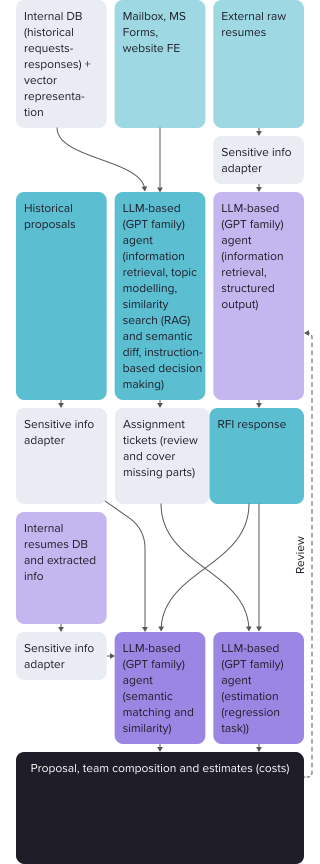
Raw resumes (from external sources) are received and passed through the Sensitive Info adapter to filter out confidential data.
RFIs (Requests for Information) arrive from different sources (mailbox, MS Forms, web interface). Since this is typically public information, the sensitive adapter is unnecessary.
The LLM-based agent (information retrieval, structured output) processes resumes and extracts structured details.
The structured data is then stored in our Internal Resumes DB for future matching and retrieval.
An LLM-based agent (information retrieval, topic modelling, similarity search, RAG, and instruction-based decision-making) decomposes requests into meaningful parts and matches chunks with the internal DB, which contains historical responses/cases/experience and their vector representations.
It generates assignment tickets for SMEs to verify, refine, or complete missing information if needed.
Another LLM-based agent (semantic matching and similarity) matches the RFI requirements with relevant candidates' skillsets from the Internal Resumes DB (which contains the outputs from the previous agent).
A separate LLM-based agent (estimation – regression task, where the underlying NLP+ML estimator is used) inputs costs and effort based on historical information.
Both agents are used with the sensitive information adapters to ensure compliance before final output.
The commercial response is compiled, incorporating all retrieved data, estimations, and team composition.
SMEs validate and refine the final response before submission.
The finalized proposal is prepared and sent to the client (an additional conversational agent can also cover the mailing/communication flow).

Our AI development experts begin by analysing your business ecosystem. Then, through collaborative workshops, we evaluate your existing systems, data infrastructure, and operational workflows to determine optimal integration points for agentic AI systems.
Based on the assessment results, our team creates a detailed implementation roadmap and prepares technical specifications for your agentic AI system. We provide the solution architecture, data flow designs, and specific agent configurations to meet your requirements.
This phase involves creating AI agents for your specific use cases, establishing monitoring systems for agent performance, and implementing necessary security protocols. We follow agile development practices to ensure continuous refinement of agent performance and smooth integration with your operational workflows.
We implement the agentic AI system within your infrastructure using a carefully planned deployment strategy. Our team ensures proper integration with existing systems while maintaining operational continuity and data protection standards.
Post-deployment, we focus on optimising agent performance through continuous monitoring and improvement. We analyse agent interactions, fine-tune decision-making parameters, and scale the system based on operational feedback. We can also provide training for your team.
Agentic AI FAQ
The agentic approach in AI involves creating autonomous systems that perceive environments, make decisions, and act toward specific goals with minimal human input. These systems use large language models, reinforcement learning, and specialized algorithms to perform complex reasoning and interact with tools and APIs, enabling them to complete tasks usually requiring human intelligence.
An example of agentic AI is an independent research assistant capable of searching, synthesizing, and analysing information on its own. Another notable example includes an intelligent process automation system that manages multi-step business workflows and adjusts to shifting conditions.
Agentic development is a field of software engineering that focuses on creating AI systems with autonomous capabilities and goal-oriented behaviour that can interact with external environments and tools. The process involves designing AI agent architectures, implementing planning algorithms, establishing feedback mechanisms, and creating prompting systems that enable AI to maintain context awareness and execute multi-step processes independently.
An agentic AI system integrates multiple specialised AI agents that operate in coordinated hierarchies to achieve complex objectives through autonomous planning and execution. These systems consist of memory components for maintaining state, reasoning modules for decision-making, tool integration frameworks for interacting with the environment, and orchestration mechanisms that facilitate coordinated actions.
Generative AI focuses on content-creation tasks like generating text, images, or code based on prompts. Agentic AI extends these capabilities with autonomous decision-making, planning, and tool utilization to accomplish multi-step objectives. Agentic systems build upon generative AI models by incorporating memory, goal-oriented reasoning, and the ability to take independent actions across multiple iterations.
Data engineering
solutions
What you get with ELEKS' data engineering services
ELEKS' comprehensive data engineering services transform raw data into strategic business assets, covering the entire data lifecycle from initial audit to strategy development, monetisation, and performance optimisation. Our expert data engineering team delivers tailored solutions that enhance decision-making capabilities, establish efficient data processes, and create new revenue streams, all while ensuring data security and compliance.
By partnering with ELEKS, businesses gain access to specialised expertise in artificial intelligence and machine learning, business intelligence, big data solutions, and modern data platforms that can scale efficiently with growing demands. Our structured approach to data engineering enhances organisational collaboration, reduces time-to-insight, and unlocks the full potential of your information assets.
Our data engineering services and
solutions covering the entire data lifecycle
Our team of data engineers and software development experts assess your organisation's infrastructure, technologies, policies, procedures, and processes throughout all data lifecycle stages. Following the data audit, we produce a report containing a detailed overview of your data ecosystem, highlighting risks and providing actionable recommendations for improvement.
We develop a tailored and comprehensive data strategy for managing your company's data assets, which includes a migration roadmap from the current state to the desired state of data architecture. This strategic approach effectively addresses data challenges by establishing customised parameters for efficient, secure, and compliant processes that align with and support your core business objectives.
Our business intelligence experts assist you in implementing comprehensive reports and customised dashboards that transform raw data into actionable insights, highlighting patterns, trends, and anomalies. You will gain valuable insights into your customers, products, assets, and operations, providing your organisation with a competitive advantage through evidence-based decision-making and strategic planning.
We transform your company's data into quantifiable economic advantages through expert data monetisation services. Our approach helps create new revenue streams, reimagine customer experiences, and optimise business operations by identifying and leveraging untapped value in your existing data assets and establishing sustainable data-driven business models.
Our DevOps experts and data engineering consultants establish robust delivery and change management processes for your data, models, and related assets. By employing established methodologies and best practices in data engineering, we empower your organisation to process and analyse data significantly more swiftly, reducing time-to-insight and enhancing operational efficiency.
We help you improve your data management efficiency by facilitating migration between vendors or transitioning from traditional data warehouses to cloud-enabled big data services. Our structured approach ensures seamless migration from legacy systems to modern platforms. We ensure minimal disruption while maximising performance gains and future scalability options for your organisation.
Our data governance and data quality services help you implement comprehensive policies and standards to enhance data security, availability, compliance and usability. We establish clear frameworks for data ownership, access controls, and quality metrics that ensure regulatory compliance. You'll be able to maximise the strategic value of your information assets across the enterprise.
We design and implement comprehensive data storage solutions and modern data platforms tailored to your specific business requirements. These solutions can be complemented by flexible data lakes for storing diverse data types in their native formats. Such an integrated approach enables efficient data processing, provides scalability and supports artificial intelligence and machine learning applications across your entire data ecosystem.
Our big data engineering services help organisations process, analyse and derive value from complex datasets that exceed traditional database capabilities. We implement scalable architectures to handle high-volume, high-velocity, and high-variety data streams. Our bespoke solutions enable real-time processing, advanced analytics, and actionable insights from previously unmanageable data, enabling new operational efficiencies.
We analyse and enhance the performance of your data systems through specialised optimisation techniques, identifying bottlenecks and implementing targeted solutions. Our approach includes refinements to data architecture that significantly improve processing speeds, reduce costs, and ensure your data infrastructure scales efficiently with growing demands.
The benefits of
data engineering services
Deploy an actionable data strategy that provides a robust framework for processing and analysing information across your enterprise. This unified approach to data management enhances organisational collaboration, ensures regulatory compliance, drives data ROI and unlocks the full potential of your information assets.
Transform raw data into actionable intelligence with our expert data analytics, data management, and BI solutions. You can start leveraging insights that enable leadership to identify trends, predict outcomes, and make strategic decisions.
Our comprehensive data engineering services will support your organisational growth by enabling you to analyse data significantly faster, reducing time to insight, and improving operational efficiency. You'll be able to identify opportunities, optimise operations, and create competitive advantages that drive sustainable business development.
Optimise data workflows through streamlined architectures that minimise processing time and system downtime. Our engineering approach incorporates automated pipelines, performance monitoring, and resource optimisation to ensure operational continuity and maximise system availability.
Implement thorough governance policies and procedures that protect information integrity and sensitive assets. Our systematic approach to data management establishes quality controls, security protocols, and compliance measures that foster trust in your data ecosystem.
Our team of data engineers evaluates your current data infrastructure and business needs to devise a customised data strategy and roadmap. We work closely with your stakeholders to pinpoint opportunities, potential challenges, and KPIs.
Following the roadmap, we create a comprehensive data infrastructure that includes tailored data pipelines, data warehouses, and governance frameworks through iterative delivery cycles.
We assist your transition from legacy platforms with a carefully crafted strategy that prioritises operational continuity, data security, and minimal disruption to business.
We establish comprehensive data governance frameworks and automated quality control protocols to ensure accuracy, completeness, and consistency throughout your data ecosystem.
We employ sophisticated monitoring systems that offer real-time insight into the performance of your data infrastructure, usage patterns, and potential issues before they affect operations.
Why choose ELEKS for data engineering services

Data engineering FAQ
Data engineering is the practice of designing, building, and maintaining systems necessary for storing, processing, and retrieving organisational data. It involves developing automated pipelines that transform raw data from various sources into structured formats that can be easily accessed for analytics and business intelligence. Data engineering empowers organisations to convert information assets into insights for strategic decision-making.
Data engineering facilitates quicker, more informed decision-making by ensuring timely access to dependable data. Furthermore, data engineering establishes the foundation for advanced analytics, artificial intelligence implementation, and data-driven innovation that fosters competitive advantage.
Data engineering designs and builds infrastructure and data pipelines to collect, store, and prepare data for analysis. Data science uses statistical methods and machine learning on this prepared data to extract insights, identify patterns, and develop predictive models.
Your business probably requires data engineering services if you face challenges such as slow reporting cycles, inconsistent data among departments, difficulty scaling your data infrastructure, or an inability to effectively integrate multiple data sources.
Modern data engineering uses a diverse technology stack, including frameworks like Apache Spark and Databricks for large-scale data processing. Database technologies range from relational databases (MS SQL Server, PostgreSQL, Oracle DB, MongoDB) to NoSQL solutions (Azure Cosmos DB, Amazon DocumentDB, MongoDB, Apache Cassandra), cloud warehouses (Snowflake, BigQuery, Redshift) and cloud analytical suits like Azure Synapse Analytics and Databricks Lakehouse. The ecosystem also includes orchestration tools like Airflow, streaming tools Apache Kafka, containerisation with Docker, Kubernetes and languages like Python and SQL for data transformation.
ETL (Extract, Transform, Load) and ELT (Extract, Load, Transform) tools are specialised software solutions that automate the process of extracting data from various sources, transforming it to meet business requirements, and loading it into target databases or data warehouses for analysis.
Data engineering is pivotal to cloud migration. This practice involves designing architectures that support data assets while ensuring performance, security, and cost efficiency. Data engineers develop strategies to transfer data between on-premises systems and cloud platforms. They frequently redesign data pipelines to leverage cloud-native services for improved scalability and reduced maintenance.
Digital accessibility solutions
What you get with ELEKS’ digital accessibility services
Make your digital presence barrier-free to all users, driving greater customer engagement and enabling new revenue streams. Our team of experienced accessibility experts and certified design specialists will help ensure your digital products and services are inclusive and compliant with web accessibility standards like ADA, Section 508, and WCAG, shielding your organization from legal consequences and reputational risks.
When you partner with ELEKS for digital accessibility services, you unlock transformative business impact. With over 30 years of custom software experience, we are uniquely equipped to help you deliver digital experiences that are accessible, sustainable and revenue-boosting.
How digital accessibility
solutions benefit your business
Digital accessibility removes barriers to interaction enabling better customer experience, so users can seamlessly engage with your products and services. By catering to diverse user needs, you'll foster greater brand loyalty, positive sentiment, and long-term customer relationships.
Expanding your pool of potential customers through inclusive design opens up new revenue streams. You will reach broader audiences, enlarging your market share and tapping into previously underserved segments. Digital accessibility also helps increase website traffic, conversions, and overall sales.
Meeting accessibility standards is not just the right thing to do - it's the law. Our accessibility services help you ensure your platform, and all digital assets, fully comply with relevant regulations in multiple markets, protecting your organization from costly legal issues, potential fines, and the risk of lawsuits.
Investing in accessibility is a strategic business decision that pays off. By making your online presence inclusive, you'll maximize the value of your enterprise digital transformation efforts and technology investments, driving a more substantial ROI for your business.
Types of platforms that we focus on
-
Websites
We enhance accessibility for mobile and desktop web apps, ensuring seamless user experiences across devices and platforms. Our approach considers the unique challenges of responsive design and varying screen sizes to create inclusive and barrier-free digital environments that cater to all users' needs.
-
Mobile applications
Our expertise covers native mobile apps, wearable apps, and Progressive Web Apps (PWAs), addressing the diverse landscape of mobile accessibility. We optimize these applications for various input methods, screen readers, and assistive technologies, ensuring your mobile presence is fully inclusive and user-friendly.
-
Software tools
We improve accessibility for multiple types of custom applications from desktop software to web and cloud-based apps by creating intuitive interfaces and workflows. Our solutions ensure that your software tools are compatible with assistive technologies and adhere to accessibility standards, making them usable by individuals with diverse abilities.
-
Specialized applications
Our accessibility services cover various specialized platforms, including chatbots, embedded systems, game consoles, AR/VR apps, smart TV apps, IoT devices, and voice-activated platforms. We tailor our approach to the unique characteristics of each platform, ensuring that even the most innovative and complex applications are accessible to all users.
We evaluate your digital platform against accessibility standards and digital accessibility practices, analyzing user interactions while prioritizing and detailing all issues. The result of our digital accessibility testing is a comprehensive report that outlines accessibility regulation compliance gaps, prioritized by severity, and includes actionable recommendations for enhancement.
We conceptualize a redesign approach for your platform, then develop prototypes and mockups incorporating necessary changes. Our deliverables address all accessibility issues identified during the audit phase and are prepared for testing and implementation.
In this phase, we conduct tests with individuals representing various disabilities or users of different assistive technologies, meticulously documenting and analyzing the outcomes. The results are compiled into a thorough report. We handle user profiling and recruitment to ensure unbiased and representative feedback for accessibility testing.
Following the testing phase, we implement the desired changes, enhancing your platform's features and functionality with an accessible design. After rigorous testing, we proceed with the delivery and launch of your upgraded digital platform, ensuring it meets all legislative requirements and incorporates improvements based on user testing insights.
Accessibility standards and
regulations we focus on
- European Accessibility Act (EAA)
- EU Web Accessibility Directive
- The Equality Act 2010
- Public Sector Bodies Accessibility Regulations 2018
- The Americans with Disabilities Act (ADA)
- Section 508 of the Rehabilitation Act

Healthcare
- Mobile, web and cloud-based telemedicine applications
- Accessible patient management portals
- Secure data storage solutions
- Wearable apps and IoT devices for real-time health monitoring and diagnostics

Finance
- Secure, robust platforms, including desktop software and mobile apps
- Cloud-based applications for banking and investment management
- Accessible systems for streamlined financial transactions

Retail
- Accessible websites, mobile apps, progressive web apps
- IoT devices to enhance online shopping, customer engagement
- Connected solutions for inventory management

Entertainment
- Accessible mobile apps and web applications
- Inclusive smart TV apps
- Game consoles for multimedia content
- Gaming and streaming services

Education
- Inclusive websites, mobile apps
- AR/VR applications to provide interactive learning experiences
- Barrier-free virtual classrooms and inclusive online learning resources
Automotive
- Accessible embedded systems and IoT devices
- Inclusive AR/VR apps for advanced driver-assistance systems (ADAS)
- Vehicle diagnostics and immersive user experiences

Smart home
- Accessible embedded systems
- Inclusive IoT devices and voice-activated platforms
- Barrier-free connected environments for household management with automation and remote control

FinOps Cloud Services
What you get with ELEKS' cloud FinOps services
ELEKS' cloud FinOps service offers a structured approach to help companies reduce the costs of the cloud and improve the usage of resources. Our expertise provides a complete approach; we help you optimise your cloud spending with practical solutions.
A certified team of cloud experts works with you to identify unused resources, resize infrastructure, and leverage cost-saving payment models to ensure you stop overpaying for cloud services. Our focus on ROI means we deliver a unique FinOps implementation that drives actual cloud cost optimisation for your business.
This phase estimates cost reduction and evaluates efficiency margins in your existing system. Our cross-functional team provides a holistic evaluation of your cloud infrastructure, financials, and related activities. The outcome is a comprehensive overview of your current data, valid for independent next steps, with optional deep analysis for a thorough diagnosis.
Our specialists implement selected actions from our diagnosis and provide detailed guidelines for cloud cost management. We offer exhaustive documentation and consulting for periodic check-ins. Our guidelines, tailored to your team structure, are supported by individual sessions and scheduled follow-ups.
After optimising cloud expenses, you can apply the same efficient approach and FinOps practices to new cloud projects. We provide specifics for setting up new projects on the updated infrastructure and ongoing support, including regular check-ins and guidance. We also help you introduce KPIs essential for monitoring cloud infrastructure and ensuring everything stays on track.

How our FinOps services
streamline the cloud cost
management
-
Managing cloud investments effectively
As demand for cloud usage and resources grows, so do monthly budgets. We help you optimise your spending with tailored cloud cost optimisation strategies and FinOps best practices, going beyond basic training to implement practical solutions. Our approach ensures you only pay for what you use so you can allocate your resources more efficiently, maximising your return on investment.
-
Gaining visibility into cloud spending
We help you enable comprehensive visibility into your cloud spending across various services, regions, and accounts. This allows you to identify cost optimisation opportunities and effectively monitor expenditure. This transparency empowers you to make informed decisions and manage your cloud budget proactively.
-
Meeting compliance and governance requirements
Our certified cloud experts assist you in handling compliance and governance requirements that impact cloud spending, including cost management policies, controls, and reporting mechanisms. We ensure your cloud operations adhere to industry standards and regulatory requirements. Our services reduce non-compliance risk, which can lead to costly fines and reputational damage, safeguarding your organisation's interests.
-
Getting expert guidance for rightsizing infrastructure
Leverage our expertise in cloud operations, economics, architecture, and optimisation techniques to manage cloud costs efficiently. We help you determine the optimal size and type of cloud resources to match your workload demands. This ensures your infrastructure is neither over-provisioned nor under-resourced, providing the perfect balance for performance and cost. Our continuous monitoring and adjustments ensure ongoing efficiency and effectiveness.
-
Maintaining an up-to-date system while managing cloud costs
Navigating the complexity of cloud environments can be challenging. Our certified cloud team ensures your infrastructure runs smoothly, stays up-to-date, and scales on demand. We provide continuous support and monitoring to detect and resolve issues before they impact your operations. This proactive management minimises downtime and helps you stay ahead of technological advancements, maintaining operational excellence.
-
Aligning infrastructure with changing business priorities
Adapting to evolving business requirements is crucial. We help ensure your cloud infrastructure scales with your future business needs and aligns with your company's short-, mid-, and long-term growth plans. Our strategic planning and implementation services ensure your cloud setup remains agile and responsive to market changes. This alignment guarantees that your infrastructure supports your business objectives, driving sustained growth and success.
Cloud technologies and
FinOps tools we apply
AWS Budgets
AWS Cost and Usage Reports
AWS Compute Optimizer
AWS Cost Explorer
AWS Cost Anomaly Detection
Cost Management Advisor
Azure Reservations
Azure Hybrid Benefit
Power BI Reports
Our partnerships and
certifications
AWS Advanced Tier Services Partners
Microsoft Solutions Partner
The Cloud FinOps services FAQ
FinOps differs from traditional IT financial management by focusing on real-time cloud cost optimisation and collaboration across engineering, finance, and business teams. Traditional IT financial management typically involves static budgeting and cost allocation, while FinOps is agile and continuously adapts to the dynamic nature of cloud usage. FinOps leverages automation and advanced analytics to provide instant visibility into cloud spending, enabling immediate action to control costs. This approach promotes financial accountability and efficiency, optimising cloud investments for maximum business value.
FinOps and DevOps have different purposes within an organisation. FinOps focuses on the financial management of cloud resources, aiming to optimise costs and ensure financial accountability. DevOps concentrates on collaboration between development and operations teams to improve software delivery and operational efficiency. While FinOps addresses the financial aspects of cloud usage, DevOps targets the technical processes and workflows for faster, more reliable software releases. Both practices are essential for maximising the value and performance of cloud services.
The three FinOps phases are Assess, Optimise, and Grow. The Assess phase is usually dedicated to the assessment and analysis activities and focuses on gaining visibility into cloud spending and understanding usage patterns. The Optimize phase involves identifying and implementing cost-saving opportunities, such as rightsizing resources and leveraging discounts. The Grow phase includes building and executing a strategy that ensures ongoing financial accountability and cost management through continuous monitoring and adjustments. Together, these phases enable a proactive approach to managing cloud financial operations.
Cloud cost optimisation is part of the FinOps practice, which involves analysing and managing cloud usage to balance costs while maximising efficiency and performance. By implementing cloud cost optimisation, businesses can optimise their infrastructure costs, enhance financial predictability, and improve resource utilisation. Ultimately, cloud cost optimisation ensures that your cloud infrastructure delivers the highest possible value for your investment.
Effective cloud cost optimisation strategies include rightsizing resources, leveraging reserved cloud instances, and implementing automated cost monitoring. Rightsizing involves adjusting the size and type of cloud resources to match actual workload requirements, avoiding over-provisioning.
The breadth of knowledge and understanding that ELEKS has within its walls allows us to leverage that expertise to make superior deliverables for our customers. When you work with ELEKS, you are working with the top 1% of the aptitude and engineering excellence of the whole country.

Right from the start, we really liked ELEKS’ commitment and engagement. They came to us with their best people to try to understand our context, our business idea, and developed the first prototype with us. They were very professional and very customer oriented. I think, without ELEKS it probably would not have been possible to have such a successful product in such a short period of time.

ELEKS has been involved in the development of a number of our consumer-facing websites and mobile applications that allow our customers to easily track their shipments, get the information they need as well as stay in touch with us. We’ve appreciated the level of ELEKS’ expertise, responsiveness and attention to details.